
Skin Rejuvenation & Acne Solutions
Medically reviewed by Stefanie Drozd, MSN-APRN · Last reviewed [date]
The short answer: Microneedling is generally safe with a qualified provider, proper screening, and a conservative-first protocol, but only if you’re a candidate. Common side effects (redness, mild swelling, flaking) resolve within days. Less common side effects (infection, persistent erythema, post-inflammatory hyperpigmentation) are real but rare with correct technique. Several conditions and medications are absolute contraindications. Here’s the honest list.
This is one of the harder pages on our site to write because we want it to be useful, not scary. Microneedling is, on balance, one of the safer device-based aesthetic procedures available, when it’s matched to the right patient and performed by a trained provider. The risks are real, though, and the right way to handle that is to tell you about them clearly.

Expected Side Effects (Most Patients Will Experience These)
These are normal and resolve on their own within a few days. They’re not complications.
- Mild-to-moderate redness, visually similar to a mild sunburn; resolves over 1 to 3 days
- Mild swelling, usually face-wide, peaks at 12 to 24 hours, resolves within 48 hours
- Dryness and mild peeling, typically days 2 to 4; sometimes minimal, sometimes more pronounced; both normal
- Pinpoint bleeding during the session, controlled and expected; ceases within minutes of the pass ending
- Skin sensitivity to skincare products, for 5 to 7 days while the skin barrier rebuilds
- A mild sunburn-like sensation, for the first 24 to 48 hours
If your recovery looks like the above list, your microneedling went well.
Less Common Side Effects (Rare but Real)
These do happen, and the responsible thing is to name them honestly.
Infection. Rare with sterile single-use cartridges (the standard at Express), but not impossible. Signs: increasing redness, warmth, pus, or fever beyond 72 hours. Treatable; call us immediately if you see these signs.
Persistent erythema. Redness lasting beyond 7 days. Uncommon; usually resolves with time but warrants a call.
Post-inflammatory hyperpigmentation (PIH). Dark patches appearing in the treated area in the weeks following treatment. Risk is higher in Fitzpatrick IV-VI skin and patients with a history of PIH. Mitigated by proper protocol calibration, pre-treatment topical regimen for darker skin, and strict sun protection.
Granuloma formation. Rare immune response forming small bumps under the skin. Generally associated with topical products containing certain ingredients used during the procedure. We use only protocol-cleared products.
Tram-track scarring. Linear marks that follow the path of an inappropriately performed microneedling pass. Associated with poor technique, pressing too hard, using an unsuitable device, or repeating passes too aggressively. Provider experience matters disproportionately on this risk.
Allergic reactions to topical numbing or post-treatment products. Uncommon but possible; we screen for known allergies at consult.
Peer-reviewed studies of microneedling adverse events (Hou et al., among others) put serious-adverse-event rates very low when the procedure is performed in a clinical setting with proper screening.
Who Should NOT Get Microneedling, Absolute Contraindications
These conditions and circumstances make microneedling inappropriate at Express. We will not perform the procedure if any of these apply.
- Active skin infection at the treatment site. Includes herpes simplex outbreak, impetigo, fungal infection, active cellulitis. We may reschedule after the infection clears.
- Isotretinoin (Accutane) use within the last 6 months. Isotretinoin impairs wound healing for several months after the last dose; microneedling during this window risks atrophic scarring. The 6-month wait period is the AAD standard.
- History of keloid scarring. Personal or family history. Microneedling stimulates collagen formation, which can trigger keloid response in susceptible patients.
- Pregnancy. Express does not perform microneedling on pregnant patients. The general industry practice; aligns with ACOG cautions on elective cosmetic procedures during pregnancy.
- Severe active cystic acne. Mild active acne is generally fine; severe active cystic acne is contraindicated. Microneedling on actively inflamed cystic skin can spread bacteria and worsen the condition.
- Open wounds, dermatitis, or eczema flare at the treatment site.
- Recent radiation therapy to the treatment area.
- Active bleeding disorder or active anticoagulation that cannot be safely paused (specific to PRP variant, but caution applies generally).
If any of these apply to you, your NP will recommend alternatives that better fit your situation.
Relative Contraindications (Caution Required)
These conditions require discussion and case-by-case decisions:
- Autoimmune disease, lupus, scleroderma, vitiligo: case-by-case based on disease activity and current treatments
- Bleeding disorders or anticoagulant medications, possible with adjustment but requires careful planning
- Immunosuppression, HIV, chemotherapy, immunosuppressive medications
- Recent sunburn at the treatment site, wait until skin fully recovers
- Active eczema or psoriasis at the treatment site, wait until clear
- Recent Botox or filler within 1 to 2 weeks, sequencing matters; we’ll adjust timing
- History of cold sore outbreaks, prophylactic antiviral may be recommended
Mention all of these at consult. If we don’t know, we can’t plan around them.
Is Microneedling Safe During Pregnancy or Breastfeeding?
Pregnancy: No. Express does not perform microneedling on pregnant patients. Cosmetic procedures during pregnancy carry caution-side risk, and there’s no reason to take on that risk for an elective treatment.
Breastfeeding: Case-by-case. Topical numbing safety while breastfeeding is variable; PRP blood draw and processing involve additional medication considerations. Many breastfeeding patients do receive microneedling at Express, but the decision is made between the patient and our NP at consult.
Is Microneedling Safe for Darker Skin Tones? (PIH Risk)
Yes, with the right protocol. Microneedling for Fitzpatrick III-VI is well-established and routinely performed at Express, particularly at our Mount Greenwood location where many patients fall in this range.
That said, post-inflammatory hyperpigmentation (PIH) is the real risk. PIH happens when post-treatment inflammation activates melanocytes and produces dark patches that may persist for months. Done correctly, PIH risk is low. Done wrong, PIH risk is significant.
Our protocol modifications for Fitzpatrick IV-VI:
- Gentler needle depth at the first session, building up only if the skin tolerates it well
- Longer intervals between sessions, typically 6 weeks instead of 4
- Pre-treatment topical regimen for 4 weeks before the first session (usually hydroquinone, tranexamic acid, or both)
- Strict 14-day post-treatment sun avoidance with mineral SPF 30+ daily
- Lower-energy first session for RF variant specifically
- Closer follow-up timing, sometimes weekly photos for the first month
Provider experience disproportionately matters for darker skin tones. If you’ve been told “microneedling is safe for all skin types” without protocol modification discussion, that’s a red flag.
Can Microneedling Cause Scarring or Hyperpigmentation?
Yes, if done wrong. The honest framing is this: microneedling done well is one of the safer device-based aesthetic procedures. Microneedling done poorly can cause iatrogenic PIH, tram-track scarring, or extended inflammation.
The variables that matter:
- Provider technique, how the device is held, the speed of the pass, pressure consistency
- Device quality, sterile single-use cartridge, proper depth calibration
- Protocol match to skin type, depth and energy appropriate for Fitzpatrick
- Patient screening, keloid history, recent isotretinoin, active infections caught at consult
- Aftercare adherence, sun protection during the recovery window
Provider experience matters more than device brand. Ask your provider how many microneedling sessions they perform monthly, what their PIH rate is in their patient population, and how they modify protocol for skin types like yours.
What If I’ve Taken Accutane?
Wait 6 months from your last dose before microneedling. This is the AAD recommendation and the Express standard.
The reason: isotretinoin impairs wound healing for months after the last dose. Microneedling during the impaired-healing window risks atrophic scarring, sometimes worse than the original concern. We will not perform microneedling within the 6-month window, regardless of the dose level you were on.
What If I Have Keloid Scars?
Microneedling is an absolute contraindication for patients with personal or family history of keloid scarring. The collagen-stimulating mechanism that makes microneedling effective for atrophic scars can trigger keloid response in susceptible patients.
If you have keloid history, we’ll honestly decline microneedling and recommend a dermatology consult for alternatives. There are options for atrophic scars that carry different keloid-risk profiles, including specific topical regimens and certain laser modalities.
At-Home Microneedling vs. Clinical Microneedling, Different Risk Profiles
At-home dermarollers and clinical microneedling carry different risk profiles because they’re fundamentally different tools.
At-home (typically 0.25mm depth):
- Low collagen-induction benefit (depth too shallow for clinical effect)
- Sterility concerns (consumer cleaning ≠ medical sterilization)
- Some product-absorption benefit
- Generally low harm potential at this depth
At-home (1.0mm+ depth):
- Should not be used at home
- Real wound depth without sterile cartridge
- No depth calibration, no provider technique
- Significant infection and tram-track scar risk
Clinical microneedling (1.5 to 2.5mm depth):
- Real collagen response in dermis
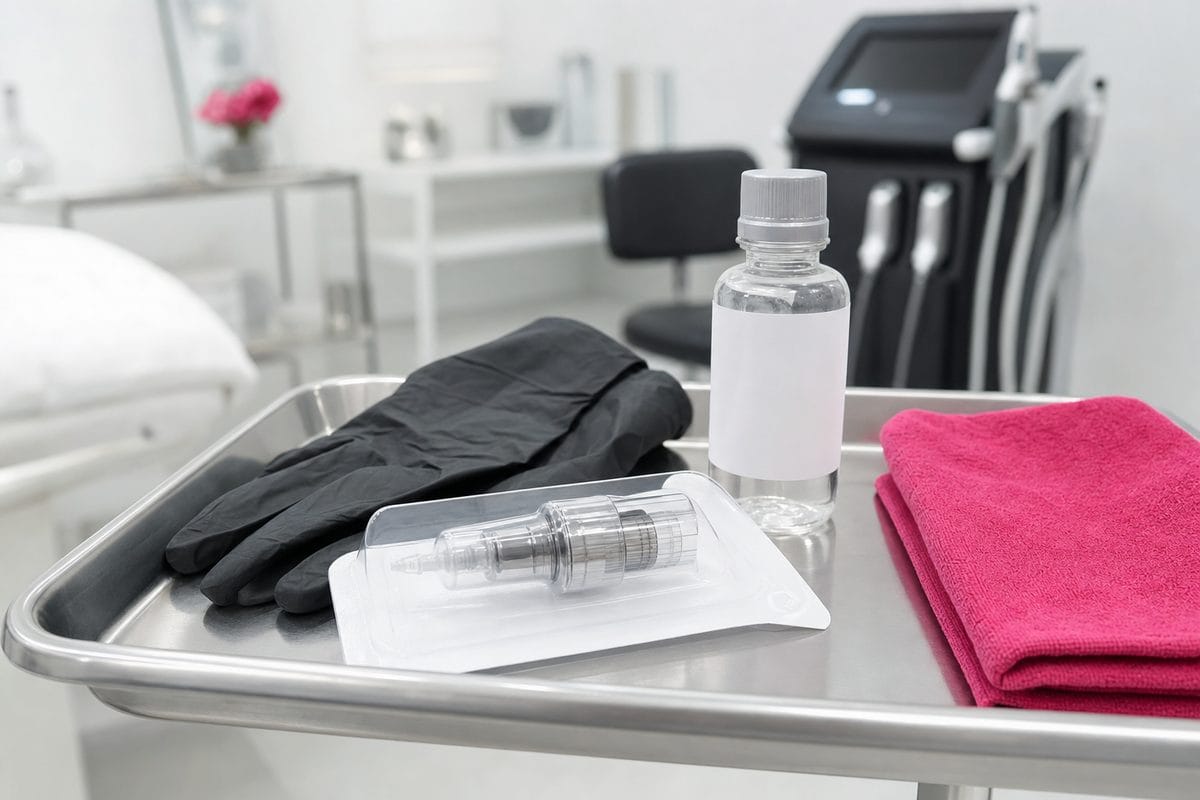
- Sterile single-use cartridges
- Provider technique, depth calibration, protocol match to skin
- Safest performance environment for clinical depth
Our position isn’t anti-at-home. It’s that the right tool depends on the goal. For light texture maintenance between professional sessions, a 0.25mm at-home roller can be reasonable. For acne scars, hyperpigmentation, or any clinical concern, at-home is the wrong tool.
What We Screen for at Express (Intake + Screening Process)
This is what your first-visit screening looks like:
- Medical history form, comprehensive, with explicit questions on isotretinoin, keloid history, autoimmune conditions, pregnancy/breastfeeding, bleeding disorders
- Medication review, anticoagulants, immunosuppressants, hormonal medications, current topical regimens
- Skin assessment, Fitzpatrick typing, active conditions (acne, eczema, psoriasis, rosacea), recent sun exposure, current product use
- Goal alignment, what you’re hoping to address, with realistic-expectation discussion before treatment
- Photo documentation, baseline photographs for comparison through your series
- Contraindication review, explicit walk-through of the absolute and relative list above
- Variant recommendation, your NP recommends the right variant for your skin and goals
If we identify a contraindication during screening, we’ll explain why and offer alternatives. We’d rather decline a treatment than perform one that’s wrong for you.
How to Choose a Qualified Provider
Whether you’re considering Express or another clinic, ask these questions:
- Who performs the treatment? Look for nurse practitioner-supervised clinical environments with a licensed medical director. Aesthetician-only microneedling at clinical depth is a flag.
- What device do you use, and what’s your depth calibration? Should be a brand-name medical-grade device, with sterile single-use cartridges and adjustable depth control.
- How many of these do you perform monthly? Volume builds technique.
- What’s your protocol for my skin type? If the answer is “the same as everyone,” that’s a flag for darker skin tones.
- What’s your PIH rate? Honest providers will give a real answer.
- What’s your follow-up schedule? A clinic without scheduled follow-ups is a clinic that doesn’t catch problems early.
- What’s your adverse-event protocol? Should be defined and on-paper.
Express welcomes any of these questions. We perform microneedling weekly at our Frankfort, La Grange, Shorewood, and Mount Greenwood clinics under direct NP supervision.
What to Tell Your Provider Before Treatment
Tell us everything, even if it feels unrelated:
- All medications (prescription, OTC, supplements)
- All skin conditions, current and past
- Recent procedures (anywhere on the body)
- Pregnancy or breastfeeding status
- Known allergies (especially to topical anesthetics, latex, metals)
- Recent sun exposure (vacations, tanning bed use)
- Hair-removal habits in the treatment area (waxing, threading, laser)
- Cold sore history
- Recent vaccinations or illness
Anything you forget to mention is something we can’t plan around.
Everything on this page applies equally to the Stem Cell Facial, which is microneedling with a stem cell derived growth factor matrix added. The needling is the same, so the screening and the safety profile are the same.
Signs You Should Call Us After Treatment
Most microneedling recoveries are uneventful. The signs that warrant a call to your Express location:
- Increasing redness, warmth, or pus beyond 72 hours
- Fever within 5 days of treatment
- Persistent severe pain
- Significant swelling beyond 72 hours
- Hives, widespread rash, facial swelling
- Unexpected pigmentation changes
- Persistent redness beyond 7 days
Call 877-363-3772 and ask for your treating location. We have NP availability for these calls.
Express’s Adverse Event Protocol (Transparency Section)
If something unexpected happens during or after a microneedling session at Express:

- Immediate clinical assessment by NP, same-day or next-business-day depending on urgency
- Documentation in your patient record
- Treatment plan, antibiotics for suspected infection, topical regimen for PIH, watchful waiting for persistent erythema
- Follow-up at appropriate intervals until resolution
- Honest review of whether the protocol could have been better calibrated for your case
- No re-treatment fees during the management period of the adverse event
We track adverse events internally and use them to refine protocols across our Frankfort, La Grange, Shorewood, and Mount Greenwood clinics.
FAQs
What’s the most common microneedling side effect? Mild-to-moderate redness for 1 to 3 days, similar to a sunburn. This is normal and expected, not an adverse event.
Can microneedling cause scarring? Tram-track scarring is rare and associated with poor technique. Iatrogenic post-inflammatory hyperpigmentation is more common and primarily a Fitzpatrick IV-VI consideration with protocol modification.
Is microneedling safe for sensitive skin? Generally yes, with conservative-first protocol and a careful patch test approach for the first session. Pre-treatment skin barrier repair is sometimes useful.
Can I get microneedling if I have rosacea? Case-by-case. Active flares are a contraindication; well-controlled rosacea may be okay with modified protocol. Discuss with your NP at consult.
Can I get microneedling if I have eczema? Treatment site must be clear of active eczema. Other body areas can sometimes be treated.
How long after Accutane can I do microneedling? 6 months from your last dose. AAD standard. Express follows it.
Is microneedling safe if I take blood thinners? Often manageable, but requires planning. Discuss your specific medication and dosing schedule with your NP. The PRP variant requires additional consideration, because it involves a blood draw as well as the needling pass.
Can microneedling trigger cold sores? Possible if you have a cold sore history. Prophylactic antiviral medication may be recommended pre-treatment if you have a known history.
Should I take antibiotics before microneedling? Generally no, unless you have a specific medical reason discussed with your NP. Prophylactic antibiotics are not standard.
What if I have a reaction, what should I do? Call us immediately at 877-363-3772 and ask for your treating location. We have NP availability for adverse-event calls.
Book a Consult
Call 877-363-3772 or book online. At consult, you’ll meet with an NP, review your medical history, and decide together whether microneedling is right for you.
- Frankfort · 11 S White St, Suite 104
- La Grange · 320 W Burlington Ave
- Mount Greenwood, Chicago · 3314 W 111th St
- Shorewood · 707 W Jefferson St, Suite M
This article reviews microneedling safety, side effects, and contraindications as Express Med Spa screens and manages them in our practice. Citations include AAD position statements, FDA device classifications, and peer-reviewed literature (Hou et al., Fabbrocini et al., AAD safety positions). This content is reviewed annually by our NP-led clinical team, last reviewed [date]. It is not a substitute for an in-person medical consultation.
Meet our nurse practitioner-led team.That’s exactly why we offer free consults.
Meet our nurse practitioner-led team.
That’s exactly why we offer free consults.
🧬 Personalized care that fits your goals.

Stefanie Drozd, APRN
Founder & Nurse Practitioner
354
5 Star Average Rating
Five Star Reviews... and growing
Let’s Talk About Your Skin Goals
You don’t have to guess what treatment is right for you. Book a complimentary consultation and let our licensed professionals help you choose the safest and most effective option. We will walk you through your options and help you decide what makes the most sense for your skin, goals, and budget.Express Med Spa Team
Share
Personalized, Judgment-Free Care
That’s exactly why we offer free consults.
🧬 Just personalized care that fits your goals.
Stefanie Drozd, APRN
Founder & Nurse Practitioner
You don’t have to guess what treatment is right for you. Book a complimentary consultation and let our licensed professionals help you choose the safest and most effective option. We will walk you through your options and help you decide what makes the most sense for your skin, goals, and budget.Express Med Spa Team
354
5 Star Average Rating
Five Star Reviews... and growing
Let’s Talk About Your Skin Goals