

Skin Rejuvenation & Acne Solutions
If you are searching for the best vitamin C serum for dark spots, here is the honest, clinical answer: a well-made vitamin C serum can gradually help fade the look of dark spots and even out your skin tone, but it works slowly and only as part of a routine that includes daily sunscreen. It is a maintenance step, not an eraser.
I am Stefanie Drozd, the founder and a nurse practitioner at Express Med Spa, a women-owned, nurse-practitioner-led practice with four locations across the Chicago suburbs. I want to be upfront about one thing: we make and sell our own Vitamin C Antioxidant Serum. So in this guide I am going to explain how vitamin C actually works on dark spots, how to judge any serum on the shelf, and where ours fits, so you can choose what is right for your skin.
One safety note first. This guide is about everyday dark spots: sun spots, age spots, post-acne marks, and melasma. If you have a spot that is new, changing, bleeding, itching, or simply looks different from the rest, that is a job for a clinician, not a serum. Have it checked.
Do Vitamin C Serums Actually Fade Dark Spots? The Science, Briefly
Dark spots, which clinicians call hyperpigmentation, happen when certain areas of skin produce extra melanin, the pigment that gives skin its color. The three you see most often are sun spots and age spots (from years of UV exposure), post-inflammatory hyperpigmentation or PIH (the marks left behind after acne or irritation), and melasma (larger patches often driven by hormones and sun).
Vitamin C helps on two fronts. As an antioxidant, it neutralizes the free radicals from sun and pollution that drive uneven pigment. It also interferes with tyrosinase, the enzyme skin uses to make melanin, which is why consistent use can lead to a brighter, more even tone over time. Published dermatology reviews describe both of these roles for topical vitamin C (Telang, 2013; Pullar, Carr, and Vissers, 2017).
The key word is gradual. In clinic and in the research, visible fading from a topical vitamin C usually takes several weeks of daily use, often in the range of eight to twelve weeks, and results vary from person to person. Melasma in particular is stubborn and tends to need more than a serum. Anyone promising overnight spot removal from a bottle is overselling it.
How to Choose the Best Vitamin C Serum for Dark Spots (What an NP Looks For)
There is no single best serum for everyone. The best vitamin C serum for your dark spots is the one with the right form and strength for your skin that you will actually use every day. Here is the checklist I give patients.
- The form of vitamin C. This is the biggest decision, so it gets its own section below. In short, you are choosing between pure vitamin C (L-ascorbic acid) and gentler, more stable derivatives. More on that next.
- A strength that suits your skin. For pure L-ascorbic acid, the research-backed range is roughly 10 to 20 percent. Higher is not automatically better, and high-percentage pure vitamin C can sting or irritate, which can actually worsen pigment in reactive skin. Derivatives are measured differently, so compare them on tolerance and formulation, not just a number.
- Antioxidant partners. Vitamin C performs best with company. Vitamin E and ferulic acid stabilize it and boost its antioxidant power, and niacinamide is a well-tolerated brightening teammate that pairs nicely with vitamin C. A serum that combines vitamin C with vitamin E and ferulic acid is following a formulation pattern that dermatologists have favored for years.
- Stability and packaging. Vitamin C is famously moody. Air and light break it down, and an oxidized serum loses potency (more on spotting that below). Look for opaque or airless packaging, and lean toward more stable forms if you are not great at using a product before it ages.
- Gentleness for your skin type and tone. If you have sensitive skin, or a deeper skin tone that is prone to post-inflammatory hyperpigmentation, gentleness matters more than raw strength. An irritating serum can leave you with more discoloration than you started with. In our practice, patients with deeper skin tones often do best starting with a gentler, lower-strength formula and building up slowly. And no matter which serum you choose, daily broad-spectrum SPF is part of the system. Without sun protection, new pigment keeps forming and your serum is fighting a losing battle.

Vitamin C Forms Explained: Why Gentle Derivatives Like Tetrahexyldecyl Ascorbate Matter
This is where most people get stuck, so let me make it simple.
L-ascorbic acid is pure vitamin C. It has the strongest, most direct research behind it for fading pigment, which is why it is often called the gold standard. The trade-off is that it is unstable (it oxidizes quickly) and it can be irritating, especially at higher strengths and on sensitive or reactive skin.
Vitamin C derivatives are modified forms designed to be more stable and gentler. Tetrahexyldecyl ascorbate is one of the better-known ones. It is oil-soluble, which helps it absorb into the skin’s lipid layers, it is more stable than pure L-ascorbic acid, and it tends to be gentler and easier to tolerate day to day. Other derivatives you will see include 3-O-ethyl ascorbic acid and sodium ascorbyl phosphate.
Here is the honest part. The strongest clinical evidence for fading dark spots specifically is still for L-ascorbic acid. Derivatives like tetrahexyldecyl ascorbate have a real and growing case, and their advantage is gentleness, stability, and consistency, not being the single most powerful pigment-fader. For a lot of people, a serum you can comfortably use every day beats a stronger one that stings and gets abandoned in a drawer.
One practical tip that comes up constantly: how do you know if your vitamin C serum has gone bad? If it has turned deep yellow, orange, or brown, it has oxidized and lost much of its potency, and a heavily oxidized serum can even contribute to staining on some skin. Store it somewhere cool and dark and replace it when the color shifts. This is one place where the more stable derivatives have an edge, since they hold up longer.
Our Nurse Practitioners’ Pick: The Express Vitamin C Antioxidant Serum
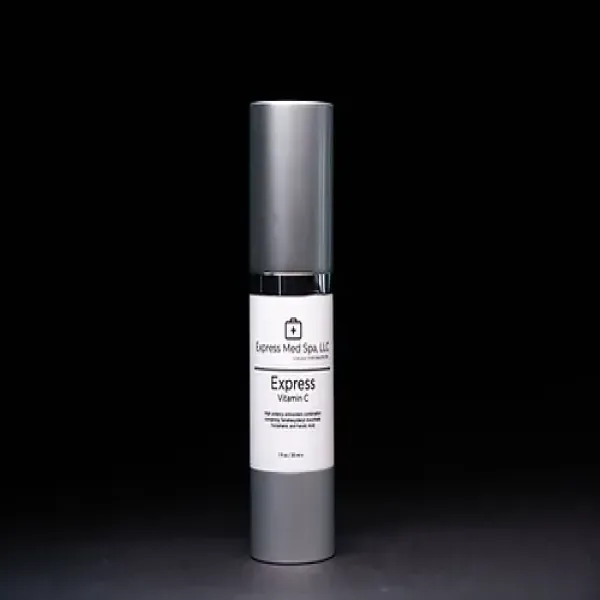
When patients ask which serum we trust enough to put our own name on, the answer is the Express Vitamin C Antioxidant Serum.
To be clear about what best means here: this is our pick for people who want a gentle, stabilized, oil-soluble form of vitamin C that is easy to tolerate in a daily routine. It is not a claim that it is the strongest pigment-fader on the market, because as I said above, that distinction belongs to high-strength L-ascorbic acid for those whose skin can handle it.
What is in it. The serum is built on tetrahexyldecyl ascorbate, the gentle and stable form of vitamin C we just discussed, and it pairs that with ferulic ester and vitamin E, the same vitamin C plus E plus ferulic combination that dermatologists have long favored for antioxidant support. Together they are formulated to provide antioxidant defense against the environmental stressors (like free radicals) that drive uneven tone, used alongside your daily SPF rather than in place of it. With consistent use it is designed to help improve the look of dark spots and uneven tone while supporting firmer, smoother-looking skin.
It is a professional, provider-curated formula we sell directly at $82*, and we keep our pricing transparent so you know exactly what you are getting. You can find it in our online shop along with the rest of our skincare collection.
Ready to add it to your routine? Shop the Express Vitamin C Antioxidant Serum.
How to Use a Vitamin C Serum for Dark Spots (and What to Pair It With)

Getting the routine right matters as much as the serum.
When to apply it. Vitamin C is a morning product for most people. After cleansing, apply it to clean, dry skin, then follow with moisturizer and, most importantly, a broad-spectrum SPF 30 or higher. I cannot say this strongly enough: sunscreen is the single most important step for fading dark spots. UV exposure is what darkens spots and creates new ones, so a vitamin C serum without daily sunscreen is effort wasted.
What to pair it with. Niacinamide pairs well with vitamin C and adds its own gentle brightening, so using both is fine. If you use a retinol or prescription tretinoin, keep that for nighttime and use your vitamin C in the morning, or alternate nights if your skin is sensitive, since stacking strong actives at once can irritate. Hyaluronic acid and a good moisturizer layer comfortably over vitamin C and help keep skin calm.
How long until you see something. Give it time. Most people need consistent daily use for about eight to twelve weeks before dark spots visibly soften, and results vary. Take a phone photo in good light when you start so you can actually judge progress, because gradual change is hard to notice in the mirror day to day.
One distinction before the options below: everything here targets flat pigment. If the spot that bothers you is raised rather than flat, a serum and a light-based treatment are both the wrong tool, and it is removed with a plasma pen instead. That is covered on our skin tag and mole removal page.
When a Serum Isn’t Enough: Faster In-Office Options for Stubborn Dark Spots

I will always tell you the truth over telling you what sells the most serum: topical vitamin C is a slow, steady maintenance tool, and for stubborn or long-standing dark spots, in-office treatments fade them faster. If your spots have not budged after a few months of diligent home care, that is usually the signal to step up.
At Express Med Spa we offer several treatments that work on pigment more directly than any serum can, including VI Peel treatments, professional chemical peels, and IPL photofacials for sun spots. Collagen-stimulating microneedling can also support overall skin renewal and is often used as part of a brightening plan. Vitamin C plays a supporting role around these treatments, and our microneedling aftercare guide explains how to time it safely.
One important caution, and this is exactly why a consultation matters: not every brightening treatment is right for every skin tone. Some peels and light-based treatments like IPL can actually worsen pigment, including melasma and post-inflammatory hyperpigmentation, on deeper skin tones if they are not chosen carefully. When a patient’s spots are not budging with home care, an in-office peel or photofacial is often the faster route, but we always match the treatment to your skin tone and the type of pigment first. There are also other topical ingredients a provider may add when vitamin C is not enough, such as niacinamide, azelaic acid, kojic acid, or tranexamic acid, chosen for your specific situation.
Want a plan built for your skin? Book a brightening consultation at one of our four Illinois locations and we will match the right approach to your skin tone and your spots.
Vitamin C Serum for Dark Spots: FAQs
Does a vitamin C serum get rid of dark spots?
It can help, but think gradual fading, not erasing. Used daily, a quality vitamin C serum gradually softens the look of dark spots and can support a more even tone over time, especially when paired with sunscreen. For deep or stubborn pigment, you will usually need an in-office treatment to see faster, more visible change.
How long does it take for vitamin C to fade dark spots?
Plan on consistency before results. Most people need roughly eight to twelve weeks of daily use before dark spots visibly lighten, and some need longer. Results vary with the type of pigment, your skin, and how reliably you wear SPF. Take a starting photo so you can track gradual progress honestly.
What fades dark spots the fastest?
Honestly, in-office treatments work faster than any serum. Professional chemical peels and IPL photofacials target pigment more directly than topical vitamin C can, and microneedling or other provider-guided protocols can be part of a personalized brightening plan. A serum plus daily sunscreen is excellent for daily upkeep, while a provider-guided treatment plan is the faster route for stubborn spots. The right mix depends on your skin.
Is vitamin C serum good for darker or deeper skin tones?
Yes, and gentleness is key. Deeper skin tones are more prone to post-inflammatory hyperpigmentation, so an irritating product can backfire and leave more discoloration. Gentle, stable forms like tetrahexyldecyl ascorbate are a smart starting point, used with daily SPF. Patch test first, and ask a provider about any spot that is changing.
Can I use vitamin C with retinol or niacinamide?
Niacinamide and vitamin C pair well, so using both is fine. With retinol or prescription tretinoin, keep the retinoid for nighttime and use vitamin C in the morning, or alternate nights if your skin is sensitive. Stacking strong actives at the same time can irritate, and irritation can worsen dark spots.
How do I know if my vitamin C serum has oxidized?
Check the color. A fresh vitamin C serum is usually clear to pale; if it has turned deep yellow, orange, or brown, it has oxidized and lost potency. Store it cool and out of direct light, and replace it when the color shifts. Stable derivatives and opaque or airless packaging help a serum last longer.
The Bottom Line
A good vitamin C serum is one of the smartest daily habits for gradually fading dark spots and keeping your tone even, as long as you choose a form that suits your skin, use it consistently, and never skip sunscreen. For stubborn pigment, pair it with an in-office treatment, and always have changing or suspicious spots checked by a clinician.
If you want a gentle, stable vitamin C built for everyday use, our nurse practitioners stand behind the Express Vitamin C Antioxidant Serum ($82*). And if your dark spots need more than a serum, book a brightening consultation at any of our four Illinois locations, and we will build a plan around your skin.
*Pricing is subject to change.
Medically reviewed and written by Stefanie Drozd, MSN, APRN, founder and medical director of Express Med Spa, a women-owned, nurse-practitioner-led medical spa serving Frankfort, Mount Greenwood (Chicago), La Grange, and Shorewood, Illinois. This article is educational and is not a substitute for individual medical advice.
Sources
- Telang, P.S. (2013). Vitamin C in dermatology. Indian Dermatology Online Journal, 4(2), 143-146.
- Pullar, J.M., Carr, A.C., & Vissers, M.C.M. (2017). The Roles of Vitamin C in Skin Health. Nutrients, 9(8), 866.
Meet our nurse practitioner-led team.That’s exactly why we offer free consults.
Meet our nurse practitioner-led team.
That’s exactly why we offer free consults.
🧬 Personalized care that fits your goals.

Stefanie Drozd, APRN
Founder & Nurse Practitioner
354
5 Star Average Rating
Five Star Reviews... and growing
Let’s Talk About Your Skin Goals
You don’t have to guess what treatment is right for you. Book a complimentary consultation and let our licensed professionals help you choose the safest and most effective option. We will walk you through your options and help you decide what makes the most sense for your skin, goals, and budget.Express Med Spa Team
Share
Personalized, Judgment-Free Care
That’s exactly why we offer free consults.
🧬 Just personalized care that fits your goals.
Stefanie Drozd, APRN
Founder & Nurse Practitioner
You don’t have to guess what treatment is right for you. Book a complimentary consultation and let our licensed professionals help you choose the safest and most effective option. We will walk you through your options and help you decide what makes the most sense for your skin, goals, and budget.Express Med Spa Team
354
5 Star Average Rating
Five Star Reviews... and growing
Let’s Talk About Your Skin Goals