
Botox, Xeomin & Filler FAQs
You are not frowning. You know you are not frowning. But the corners of your mouth sit a little lower than they used to, and in photographs you look tired, or annoyed, or sad, when you feel none of those things. That is a real and specific problem with a real and specific cause, and it has a name: the depressor anguli oris.
The short answer
What is DAO Botox? A very small dose of neurotoxin placed into the muscle that pulls the corner of your mouth downward. Weaken that muscle slightly and the muscles that lift the corner get to win more of the tug-of-war, so the corner rests a little higher.
Does it work? For the right face, yes, and often with a strikingly small amount of product. For the wrong face it does close to nothing, because the downturn was never coming from muscle in the first place. Working out which one you are is the entire consultation, and it is the part of this treatment that actually matters.
Is it subtle? Very. This is measured in millimeters. Anyone promising you a dramatic lift from two units in each mouth corner is overselling it.
The rest of this guide covers what the muscle does, how to tell muscle-driven downturn from volume-driven downturn, what a realistic result looks like, how many units it takes, what it costs, and the specific ways this treatment goes wrong when it is injected carelessly.
What the depressor anguli oris actually does
The depressor anguli oris, almost always shortened to DAO, is a thin triangular muscle on each side of the lower face. It anchors along the jawline and narrows as it travels up to the corner of the mouth, where it joins a dense knot of muscle called the modiolus.
It has one job: pull the corner of the mouth down and slightly outward. That is the anatomy of a frown. When you make a deliberately sad face, that is your DAO firing.
It does not work alone. Pulling in the opposite direction are the elevators, principally the levator anguli oris and the zygomaticus muscles, which lift the corner up and back when you smile. Every mouth corner is a permanent tug-of-war between the muscle pulling it down and the muscles pulling it up.
For most of your life those forces are roughly balanced at rest. Over decades the balance can shift. The DAO is used constantly and, like any heavily used muscle, it can become stronger and shorter, holding a degree of tension even when your face is relaxed. The elevators do not get the same workout. The result is a mouth corner that sits fractionally lower at rest than it did at thirty, which reads to other people as a mood rather than as an anatomical fact.
This is the same logic behind treating a gummy smile or platysmal bands: identify the one muscle producing an unwanted pull, and quiet it just enough to change the balance without changing how the face moves.
Why your mouth corners turn down, and why the cause decides the treatment
A downturned mouth is a description, not a diagnosis. Three different things produce it, they look broadly similar in the mirror, and they respond to completely different treatments. Injecting the wrong one is the single most common reason people are disappointed with this treatment.
Muscle pull
An overactive DAO holding the corner down at rest. This is the one neurotoxin treats, and it is the one that responds best.
Volume loss
Fat pads in the lower face shrink and descend with age, and the bone underneath them remodels. The tissue just outside the mouth corner loses its support, and a shadowed groove forms running from the corner toward the jaw. That groove is a marionette line, and it is a structural problem. Relaxing a muscle does not refill a hollow. This is marionette line filler territory, sometimes alongside pre-jowl and chin filler when the jawline has lost definition too. We cover the underlying process in more detail in our guide to facial volume loss.
Skin quality
Cumulative sun exposure and the gradual loss of collagen and elastin leave the skin itself thinner and less able to hold its shape. Where this shows up around the mouth, it tends to appear as fine vertical lines on the lip rather than as a downturned corner, and it is treated with resurfacing or with perioral line filler rather than with neurotoxin.
There is a quick test that separates the first from the second, and you can do it in front of a mirror right now. Look at your face completely relaxed and note where the corners sit. Now deliberately activate the muscle, the exaggerated sad face, and watch how far the corners travel down. Then relax and smile gently, and watch how far they travel up.
- If the corners move a long way and the resting position looks much better the instant you stop frowning, muscle is doing a lot of the work. Neurotoxin is likely to help.
- If the corners barely move, and the groove beside your mouth stays visible whether you are frowning, smiling or completely relaxed, the downturn is structural. Neurotoxin alone will disappoint you.
- If you see a bit of both, which is the most common answer past about forty-five, a combination is usually the right plan, and the sequencing matters.
That distinction, between a line your muscles create and a line that is there regardless, is the most useful concept in injectable treatment generally. We have written about it separately in dynamic vs. static wrinkles.
What DAO Botox changes, and what it does not
Treating the DAO does one thing: it removes some of the downward force on the mouth corner. What follows from that is genuinely useful, and also genuinely limited.
What it can do:
- Let the mouth corner rest a few millimeters higher, so a neutral face reads as neutral rather than as displeased.
- Soften the crease that forms immediately below and beside the corner when the DAO contracts.
- Improve the result of filler placed nearby, because the filler is no longer fighting a muscle pulling in the opposite direction.
What it cannot do:
- Fill a marionette groove. If there is a shadow because there is no volume underneath, no amount of neurotoxin will cast light into it.
- Lift jowls. Skin laxity along the jaw is a different problem with different solutions, and neurotoxin is not one of them.
- Erase fine vertical lip lines.
- Change your smile. A well-placed DAO treatment should not alter how you smile at all. If it does, it was placed badly.
It is worth being blunt about the scale of the change, because the internet is not. This is one of the most oversold treatments in aesthetics, largely because the before-and-after photographs are so easy to exaggerate with a change of camera angle, lighting, or the subject’s expression. A real DAO result is the kind of thing you notice in your own mirror and your partner cannot name. That is a point we make about neurotoxin generally in what Botox actually does.
What a realistic before and after looks like
If you are looking at DAO before-and-after photographs online, a few things are worth knowing before you judge your own expectations against them.
Here is one comparison from our own clinic, both frames taken with the face at rest.
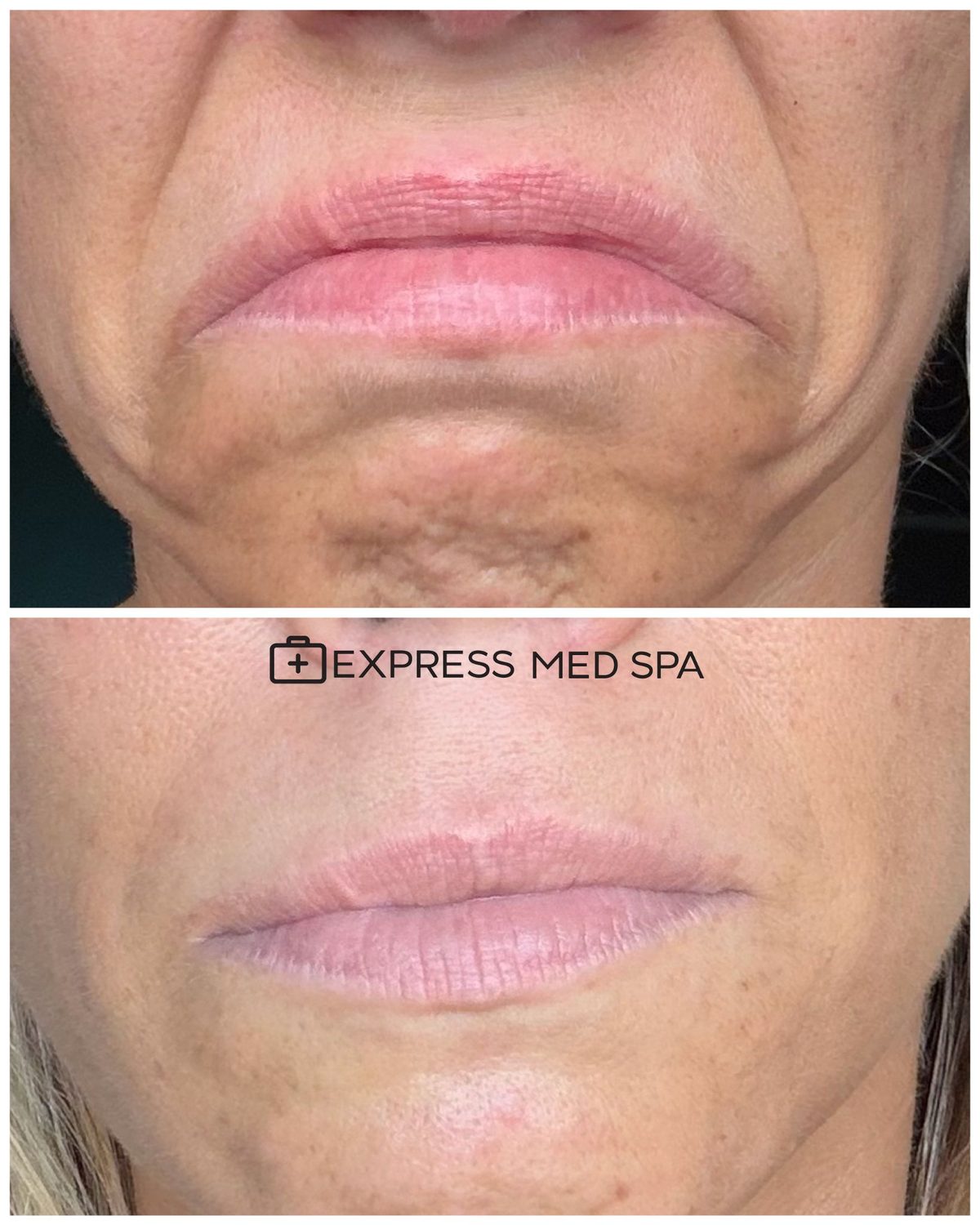
Compare like with like. The single easiest way to manufacture an impressive result is to photograph the “before” with the face slightly activated and the “after” fully relaxed. Both images should be taken at the same angle, in the same light, with the face at genuine rest. If the head tilt changes between the two frames, the comparison is worthless.
Look at the corner, not the whole mouth. The change lives in a small area: the commissure itself and the centimeter or so of skin below and beside it. A useful comparison is one where you can cover everything except the mouth corners and still see the difference.
Mind the timeline. The muscle does not relax immediately. Onset is typically three to seven days, and the effect is not fully settled until around two weeks. A photograph taken at day three is not the result. Neither is a photograph taken at four months, by which point the effect is wearing off. The honest comparison point is roughly two weeks after treatment.
Expect asymmetry, in both directions. Very few faces are symmetrical to begin with, and one DAO is frequently stronger than the other. A good injector doses each side to the muscle in front of them rather than dosing both sides identically, which means the units are sometimes deliberately uneven. Equally, a result that is slightly uneven at two weeks can usually be balanced with a small touch-up rather than waiting it out.
How many units does DAO Botox take?
Less than almost any other area of the face. Typical treatment is in the region of two to four units per side, so roughly four to eight units in total. Some injectors will start a first-time patient at two units per side deliberately, review at two weeks, and add more only if the response was weaker than hoped.
That conservatism is not timidity, and it is worth understanding why it is the correct approach here specifically. The DAO sits directly alongside two muscles you very much do not want to affect: the depressor labii inferioris, which controls the lower lip, and the orbicularis oris, the ring of muscle around the mouth itself. Product placed too high, too medially, or in too large a volume can spread into either one. More units do not buy a better result in this area; past a certain point they buy a complication.
For context, a glabellar treatment between the brows is commonly around twenty units, and a masseter treatment for jaw clenching is considerably more than that. Four to eight units is a small addition to an existing treatment plan, which is why the DAO is very often treated in the same appointment as something else rather than being the sole reason for a visit.
The product itself can be Botox, Xeomin, or Letybo. The unit count is the same whichever of the three your provider uses, so the choice comes down to how you have responded to a particular product before rather than to any difference in dosing.
What does DAO Botox cost?
Neurotoxin is priced per unit, not per area, which works in your favor here. Because the DAO needs so few units, it is one of the least expensive things you can have treated. Whatever the per-unit price is at the time you are treated, the arithmetic is that price multiplied by roughly four to eight.
Two things affect the real number. The first is that the effect lasts around three to four months, in line with neurotoxin elsewhere, so this is a recurring cost rather than a one-off. The second is that if a consultation concludes the downturn is mostly structural, the honest plan involves filler, and filler is priced per syringe and costs materially more. It is better to know that before booking than to be surprised by it in the chair.
Because so few units are involved, the DAO is also one of the areas most worth adding to an appointment you were already having rather than booking on its own. Current per-unit pricing is confirmed at consultation before anything is injected, and any package offers running at the time are listed on our specials page.
When DAO Botox is the wrong answer
Some of the most useful advice a clinic can give is that the treatment you asked for is not the treatment you need. Several distinct complaints get described as “my mouth turns down,” and only one of them is a DAO problem.
- A deep groove from the mouth corner to the jaw. That is a marionette line and it is a volume problem. Neurotoxin may improve the corner slightly, but the groove needs filler.
- Fine vertical lines on the lip itself. Perioral lines come from the orbicularis oris, from sun damage, and from thinning skin. They are treated with perioral line filler, resurfacing, or a very light dose of neurotoxin placed into a different muscle entirely.
- Loss of definition along the jaw. Softening of the jawline is largely laxity and volume, and is addressed with pre-jowl and chin filler or with skin-tightening treatment.
- A lip that has thinned and rolled inward. This changes the shape of the mouth but is not a depressor problem, and treating the DAO will not address it.
There is also a group of people for whom the right answer is simply “not yet.” If the downturn is mild, if you only see it in unflattering photographs, and if it does not bother you day to day, there is no clinical reason to start a treatment that needs repeating three times a year.
How DAO Botox goes wrong, and how that is avoided
Search for this treatment and you will find people describing bad outcomes. Those accounts are usually accurate, and they are worth understanding rather than dismissing, because the failure mode is specific and predictable.
Nearly every poor DAO result comes from the same root cause: product reaching a neighboring muscle it was not meant to reach. That produces a small number of recognisable problems.
- An uneven smile. If neurotoxin diffuses into the depressor labii inferioris, one side of the lower lip stops moving normally. The face looks fine at rest and asymmetric in motion, which is the opposite of what was wanted.
- Difficulty with straws, whistling, or certain sounds. This points to the orbicularis oris having been affected. It is a nuisance rather than a danger, but it is a noticeable one.
- A flattened or strange-feeling lower lip. Again, spread beyond the target muscle.
- No visible change at all. Less alarming and more common. Usually this means the downturn was structural rather than muscular, and the assessment was wrong before the needle was ever picked up.
The reassuring part is that every one of these resolves. Neurotoxin is temporary, so an unwanted effect fades on the same schedule as a wanted one, typically over several weeks to a few months. Nothing here is permanent. That is genuinely different from a filler complication.
Avoiding it comes down to technique rather than luck: injecting low and lateral, along the outer border of the muscle near the jawline rather than up near the mouth corner; using a small volume so the product stays where it was placed; and dosing conservatively on a first treatment. An injector who assesses your muscle by having you activate it, rather than injecting a standard pattern, is doing the thing that prevents this.
Is treating the DAO an approved use?
It is worth stating plainly, because it is a fair question and it is rarely answered directly.
Botox Cosmetic holds FDA approval for a defined set of cosmetic areas: frown lines between the brows, crow’s feet, forehead lines, and platysma bands in the neck. The depressor anguli oris is not among them. Treating it is an off-label use.
Off-label does not mean unapproved, untested, or improper. Once a medication is approved, a qualified prescriber may use it for an indication outside the label where clinical judgment supports it, and this is routine across all of medicine, not a quirk of aesthetics. A great deal of established injectable practice, including masseter treatment for jaw clenching and treatment of a gummy smile, is off-label in exactly the same way. What it does mean is that the decision rests on the training and judgment of the person holding the syringe, which is an argument for being particular about who that is.
Frequently asked questions
What does DAO stand for?
Depressor anguli oris, which translates almost literally as “the muscle that lowers the corner of the mouth.” It is also sometimes called the triangularis, after its shape.
Will DAO Botox fix my resting sad face?
If the expression is being created by muscle pulling your mouth corners down, it will help, and the change is often more meaningful to the person than its size suggests. If the impression comes from volume loss, shadowing, or a heavy brow, treating the DAO will not be the answer on its own. A proper assessment tells you which you are dealing with.
How long does DAO Botox last?
Roughly three to four months, the same as neurotoxin elsewhere. Because the dose is small, some people find it fades slightly sooner and prefer to have it topped up alongside their other areas.
How soon will I see a result?
Expect the first change between three and seven days, and the settled result at around two weeks. Judge the outcome, and any need for a touch-up, at the two-week mark rather than before it.
Can DAO Botox be combined with filler?
Yes, and for a lot of people that combination is the plan that actually works. Relaxing the depressor and restoring the lost volume beside the mouth address two different halves of the same appearance. Where both are indicated, the muscle is commonly treated first so that filler is placed into tissue that is no longer being pulled downward.
Does it hurt?
Two small injections, one on each side, with a very fine needle. Most people rate it as easier than treatment between the brows. The whole thing takes a couple of minutes.
Will it change my smile?
It should not. A correctly placed DAO treatment affects the resting position of the mouth corner and leaves your smile alone. A smile that looks different afterwards indicates the product reached a muscle it should not have, and it will resolve as the effect wears off.
Is DAO Botox worth it if I already have marionette lines?
It can be, as part of a plan rather than instead of one. Treating the muscle stops it working against the filler and can extend how good the result looks, but on its own it will not fill an established groove.
Find out whether it is your muscle or your volume
Almost everything on this page comes back to one question, and it is not a question you can settle from a photograph. Whether your mouth corners are being pulled down by a muscle, or have simply lost the support that used to hold them up, determines whether four units of neurotoxin will change anything at all. A complimentary consultation answers it in a few minutes, by watching the muscle work. If treating the DAO is not going to help you, you will be told that.
Express Med Spa treats injectables at its four Chicagoland locations: Frankfort, La Grange, Shorewood, and Mount Greenwood (Chicago). For how neurotoxin works, what it treats, and how it is dosed, see the Botox treatment page.
This article is general education and is not medical advice. Treatment of the depressor anguli oris with botulinum toxin is an off-label use. Individual results vary, and whether any treatment described here is appropriate for you is determined at a consultation with a qualified clinician.
Meet our nurse practitioner-led team.That’s exactly why we offer free consults.
Meet our nurse practitioner-led team.
That’s exactly why we offer free consults.
🧬 Personalized care that fits your goals.

Stefanie Drozd, APRN
Founder & Nurse Practitioner
354
5 Star Average Rating
Five Star Reviews... and growing
Let’s Talk About Your Skin Goals
You don’t have to guess what treatment is right for you. Book a complimentary consultation and let our licensed professionals help you choose the safest and most effective option. We will walk you through your options and help you decide what makes the most sense for your skin, goals, and budget.Express Med Spa Team
Share

Personalized, Judgment-Free Care
That’s exactly why we offer free consults.
🧬 Just personalized care that fits your goals.
Stefanie Drozd, APRN
Founder & Nurse Practitioner
You don’t have to guess what treatment is right for you. Book a complimentary consultation and let our licensed professionals help you choose the safest and most effective option. We will walk you through your options and help you decide what makes the most sense for your skin, goals, and budget.Express Med Spa Team
354
5 Star Average Rating
Five Star Reviews... and growing
Let’s Talk About Your Skin Goals