Testosterone Replacement Therapy (TRT) in Chicagoland
Lab-guided testosterone replacement therapy from the nurse-practitioner-led team at Express Med Spa, available as weekly injections or as pellets placed every 4 to 6 months. Treatment begins only after bloodwork confirms a testosterone deficiency, and your dose is adjusted from follow-up labs rather than from how you feel alone.
Book Your Consultation
Treatment TIme
15-30 min
DownTime
minimal
RESULTS TIMELINE
3-6 weeks
Result Last
Injections weekly; pellets 4-6 months
BEST FOR
Lab-confirmed low testosterone, ongoing hormone management, pellet therapy

How does testosterone replacement therapy work?
TRT supplies testosterone your body is no longer producing in sufficient amounts, with the goal of returning a lab-confirmed low level toward the normal reference range. Your nurse practitioner sets the starting dose from your bloodwork and adjusts it from follow-up labs, so the target is a measured number rather than a subjective one.
What forms of testosterone does Express Med Spa offer?
Two routes. Testosterone injections are dosed at 100mg, 150mg or 200mg and given on a regular schedule, either in clinic or at home after injection training. Testosterone pellets are placed under the skin during a short in-office procedure and release steadily for 4 to 6 months. We implant pellets for both men and women.
What happens at the first visit?
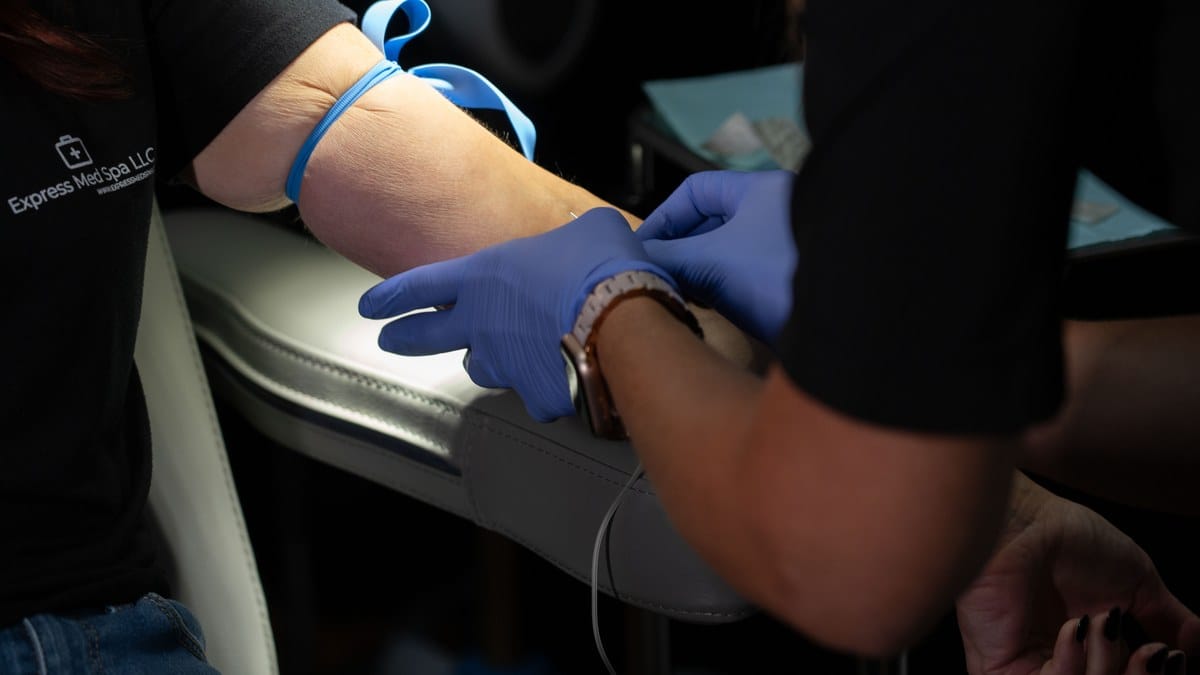
Your first visit is a consultation with labs: a physical exam, a medical history review, and a blood draw that includes total testosterone. We review those results with you before anything is prescribed. If your labs confirm a deficiency and you have no contraindications, we build a dosing plan and schedule your first treatment.
How soon do levels respond, and how long does treatment last?
Bloodwork typically shows movement within the first few weeks, and most people see meaningful change in their numbers by around 3 to 6 weeks. TRT is ongoing care rather than a one-time procedure: injections continue on your schedule, pellets are replaced every 4 to 6 months, and labs are rechecked throughout.
Should I choose pellets or injections?
Injections cost less per dose and let us change your dose quickly, but they require staying on a schedule. Pellets are placed a few times a year and hold a steadier level between visits, though the dose cannot be readily adjusted after placement. Your nurse practitioner will walk through which fits your labs, your schedule and your comfort with needles.
About This Treatment
Most people arrive here deciding between testosterone injections and testosterone pellets. This page explains how each route is dosed and monitored at our four Chicagoland clinics, and what the required lab work confirms before any prescription is written.
Treatment Pricing
From
Price
$35
Testosterone injections starting at $35 (100mg), $45 (150mg) and $55 (200mg) per administration. Pellet implantation starting at $350 for women and $550 for men. New patients begin with a consultation and labs, starting at $360 without insurance or $99 with insurance; follow-up visits with labs start at $59. Total testosterone lab starting at $91. Pricing is subject to change. A consultation is required prior to treatment, and treatment begins only after bloodwork confirms a deficiency.
View our full med spa price menu
*Pricing is subject to change.
Who Testosterone Replacement Therapy (TRT) in Chicagoland is For
Good Candidates? Is This Right for You?
Who Is a Good Candidate for Testosterone Replacement Therapy?
Candidacy is a clinical judgment, not a single number. It requires an in-person evaluation by a licensed provider, symptoms compatible with testosterone deficiency, and two separate early-morning fasting blood tests both showing a level below the normal reference range. A lab-confirmed deficiency is not optional at Express Med Spa: it is the requirement. We do not prescribe testosterone on the basis of symptoms alone, we do not prescribe on the basis of one borderline result, and we do not continue therapy for patients who will not return for follow-up labs.
For women there is no FDA-approved testosterone product, so any use is off label and is considered case by case rather than on the basis of a low reading alone.
Reasons People Ask to Be Tested
The items below are reasons people request an evaluation. They are not evidence of low testosterone, and none of them is something this treatment is promised to change. Each has other possible explanations, and several are more commonly caused by something else entirely. Bloodwork, not this list, is what distinguishes them.
- A previous lab result showing a low or borderline testosterone level
- Persistent fatigue that has already been evaluated for other causes
- Reduced muscle mass or strength despite unchanged activity
- Changes in mood, or difficulty concentrating
- Increased body fat, particularly around the midsection
- Reduced bone density identified on prior testing
- Other symptoms raised by you or by another clinician that warrant checking a level
If your panel comes back within the normal range, that is a useful answer too. Your nurse practitioner will discuss what the result means and what, if anything, is worth checking next.
Who Should Not Receive Testosterone Therapy
Testosterone is not appropriate for everyone, and some conditions rule it out entirely. Tell your nurse practitioner at consultation if any of the following apply to you:
- Active or suspected prostate cancer, or male breast cancer
- Pregnancy, breastfeeding, or trying to become pregnant
- Plans to father a child in the near term, since testosterone therapy suppresses sperm production and can impair fertility
- Untreated severe obstructive sleep apnea
- An elevated hematocrit or a history of polycythemia
- Uncontrolled heart failure, or a recent heart attack or stroke
- Severe untreated urinary symptoms related to an enlarged prostate
Safety and Supervision
Testosterone is a Schedule III controlled substance and is prescribed only under an established clinical relationship with documented laboratory justification. Every plan at Express Med Spa is written and managed by our nurse-practitioner-led team, includes a physical exam and baseline bloodwork before the first dose, and requires follow-up labs to continue. Individual results vary, and a consultation is required before treatment.
Chicagoland Med Spa Reviews
What Clients Say About Testosterone Replacement Therapy (TRT) in Chicagoland
 Kristina is AMAZINGGG! I’ve been going to Express Med Spa for a few years now and recently started going to the Shorewood location and Kristina has been awesome. She listens. She educates and you can tell she caresLeslie LathropGoogle Review
- I have been going to Mount Greenwood Express MedSpa for the past few months and have had nothing but great experiences. The facility is always clean and welcoming, the staff is friendly and professional, and the service is consistently exceptional. Yesterday, I had the opportunity to receive my treatment from the owner, and she was absolutely incredible. Her knowledge, attention to detail, and genuine care made the experience even better. I highly recommend Mount Greenwood Express MedSpa to anyone looking for outstanding service and results!Maureen DownsGoogle Review
- Great Facility! I personally see Jackie at Express medspa and let me tell you, she is one of the most personable and down to earth people I have ever met. The care and kindness she puts into making her clients feel comfortable is unmeasurable. Always greets me with a smile and a warm hello. I highly recommend visiting express medspa for their variety of services but if you want exceptional customer service…she’s your gal. I wish I could give her 10 stars. She is more than deserving of them. Dont believe me?! Make that appointment and ask for Jackie ♥️ Thank you express medspa! Your whole team is wonderful (she’s just my favorite)! -HeatherHeather StrassGoogle Review
- Shoutout to Jackie at Express Med Spa! She is seriously the sweetest medical assistant ever. From the moment I came in, she made me feel so comfortable and cared for. She’s super professional but also so friendly—it felt like I was chatting with a friend the whole time.Jackie explained everything clearly, kept checking in to make sure I was okay, and just made the whole experience stress-free. You can tell she genuinely cares about her patients and goes above and beyond to make sure you feel taken care of.If you get the chance to work with Jackie, you’re in great hands! She makes the spa experience 100x better. 💖Kaitlin KnappGoogle Review
- I had an amazing experience with Nurse Tami! She was so gentle, knowledgeable, and took the time to explain everything thoroughly. I felt completely comfortable throughout the entire process, and the results are phenomenal! I couldn’t be happier and will definitely be coming back. Highly recommend her!Kristin JayGoogle Review
- I came in for the first time and was welcomed by Addy the front desk receptionist who made me feel like I was a regular for years. I was brought to the back where the nurse Angelika answered all my questions in great detail and made me feel comfortable asking any questions that I had without making me feel bad. Thank you so much for the kind and amazing experience! I will be coming backJoel MohammedGoogle Review





Contraindications & Risks / Side Effects
Contraindications
Active or suspected prostate cancer
Male breast cancer
Pregnancy, breastfeeding, or actively trying to conceive
Plans to father a child in the near term (therapy suppresses sperm production)
Untreated severe obstructive sleep apnea
Elevated hematocrit or a history of polycythemia
Uncontrolled heart failure, or recent heart attack or stroke
Severe untreated lower urinary tract symptoms from an enlarged prostate
Known hypersensitivity to testosterone or to any component of the formulation
Unwillingness to complete the required baseline and follow-up laboratory testing
Risks / Side Effects
Injection-site soreness, redness or bruising, typically short lived
Acne or increased skin oiliness
Fluid retention or mild swelling in the ankles
Increased red blood cell concentration (hematocrit), which is why bloodwork is repeated
Reduced sperm production and testicular volume, which can affect fertility
Increases in blood pressure, which is monitored during therapy
Cardiovascular risk requires individual assessment and is discussed at consultation
Mood changes, irritability, or changes in sleep
Breast tenderness or enlargement
Changes in cholesterol values
For pellets: site soreness, bruising, or rarely pellet extrusion before it dissolves
For pellets: a small risk of bleeding or infection at the implantation site
Worsening of untreated sleep apnea
Chicagoland Medical Spa
EXPRESS MED SPA LOCATIONS
Experience our expert aesthetic treatments and personalized care at our convenient Express Med Spa locations. Whether you're looking for Botox, weight loss programs, or laser hair removal, we provide advanced beauty and wellness services across our four Chicago suburbs locations.

Med Spa Frankfort, IL
Our Express Med Spa Frankfort
clinic serves Will County with nurse practitioner-led Botox,
fillers, GLP-1 weight loss,
and laser hair removal.
Frankfort, IL
60423
(708) 840-8443
Get Directions

Med Spa Shorewood, IL
Our Express Med Spa Shorewood
clinic serves Joliet, Plainfield, and the I-80 corridor
with injectables, GLP-1 weight loss,
and skin care.
Shorewood, IL
60404
(877) 363-3772
Get Directions

Med Spa La Grange, IL
Our Express Med Spa La Grange
clinic serves the western suburbs with Botox, fillers,
IV therapy,
and GLP-1 medical weight loss.
La Grange, IL
60525
(708) 847-0872
Get Directions

Med Spa Mount Greenwood, Chicago IL
Our Express Med Spa Mount Greenwood
clinic serves Chicago's South Side and southwest Cook County
with nurse practitioner-led injectables, GLP-1 weight loss.
Chicago, IL
60655
(877) 363-3772
Get Directions

Med Spa Manteno, IL
Our Express Med Spa Manteno
clinic serves Manteno and nearby communities
with nurse practitioner-led injectables, GLP-1 weight loss.
Manteno, IL
60950
(877) 363-3772
Get Directions
Each medical spa location is led by a licensed Nurse Practitioner, with a focus on safe, results-driven care.
What To Expect
Pre & Post Treatment Care
Pre-Care Instructions
Schedule your testosterone draw for the early morning and come fasting, since the level follows a daily rhythm and diagnosis requires two separate early-morning fasting tests
Follow any additional fasting instructions given for the other panels drawn alongside your testosterone test
Bring a complete list of current medications and supplements, including anything hormonal
Tell us about any testosterone or hormone product you are taking from any outside source, including pellets already implanted. Do not stop a prescribed hormone on your own; we will coordinate timing with you and with the prescriber so baseline labs are interpretable
Be ready to discuss prostate, cardiac and sleep history, plus any plans to father a child
For a pellet implantation, wear loose clothing and arrange to skip heavy exercise that day
Post-Care Instructions
Keep the pellet site clean and dry, and leave the dressing in place as directed
Avoid swimming, baths and hot tubs for 5 to 7 days after a pellet implantation
Avoid heavy lifting and vigorous lower-body exercise for 24 to 48 hours after pellet placement
Expect some bruising or tenderness at the site, and use a cold compress if needed
Rotate injection sites if you self-administer, and dispose of sharps in an approved container
Keep your follow-up lab appointment, since dose decisions are made from those results
Report fever, spreading redness or drainage at the implantation site to the clinic promptly
Report chest pain, severe shortness of breath, or swelling in one leg without delay

CommON QUESTIONS
Testosterone Replacement Therapy (TRT) in Chicagoland FAQs
 Nurse Jackie Umgelder 09.24.26
GLP-1 vs. Phentermine: Which Weight Loss Medication Fits You?
GLP-1 medications and phentermine work differently, are taken differently, and are screened differently. See how they compare, and how our nurse practitioner team decides…- Nurse Jackie Umgelder 09.24.26
Who Qualifies for Weight Loss Injections? A Free Consult Decides (Video)
Who qualifies for weight loss injections? Watch Jackie Umgelder, Lead Medical Assistant at Express Med Spa, explain how a free consultation with our nurse…  Nurse Stefanie Drozd 09.23.26
When to Start Preventative Botox (Baby Botox): Age, Units, and Pricing
Baby botox starts when lines linger, not on a birthday. Age signs, 30 units for $329, and when a standard dose is the more… Nurse Stefanie Drozd 09.22.26
Microneedling with PRP Cost: Face, Acne Scars, and What You Actually Pay for Results
Microneedling with PRP cost at Express Med Spa is $490 for a full face. Series math for acne scars, vampire facial cost, and when…- Nurse Stefanie Drozd 09.21.26
Botox for TMJ: What It Helps, What It Cannot Fix, and How Many Units You Need
Botox for TMJ can lower clenching force when the masseter is the problem. What it helps, what it cannot fix, typical units, and when… - Nurse Stefanie Drozd 09.19.26
Who Is a Good Candidate for Laser Hair Removal? (Video)
Who is a good candidate for laser hair removal? Watch Express Med Spa esthetician Kaitlin Knapp explain why darker, coarser hair responds and why… - Nurse Stefanie Drozd 09.19.26
Does Laser Hair Removal Work on Blonde, Gray, or Red Hair?
Laser hair removal usually does not work well on blonde, gray, white, or red hair because the laser targets pigment. Here is what to…  Nurse Lily Zelaya 09.18.26
How to Get Rid of Bunny Lines with Xeomin | Quick Nose Wrinkle Fix at Express Med Spa La Grange
Learn how Xeomin can quickly smooth away bunny lines on your nose. Quick nose wrinkle fix at Express Med Spa in La Grange, IL.…- Nurse Lily Zelaya 09.18.26
How to Get Rid of Bunny Lines with Xeomin (and Botox)
Bunny lines are the diagonal, crinkling wrinkles that appear on both sides of the bridge of your nose when you scrunch your face, laugh,…  Nurse Lily Zelaya 09.18.26
Watch: Why Our Nurse Injector Switched to Xeomin | Xeomin vs. Botox
Lily Zelaya, RN, explains why she switched to Xeomin over Botox, how double-filtration removes excess proteins to prevent resistance, and what to expect.…