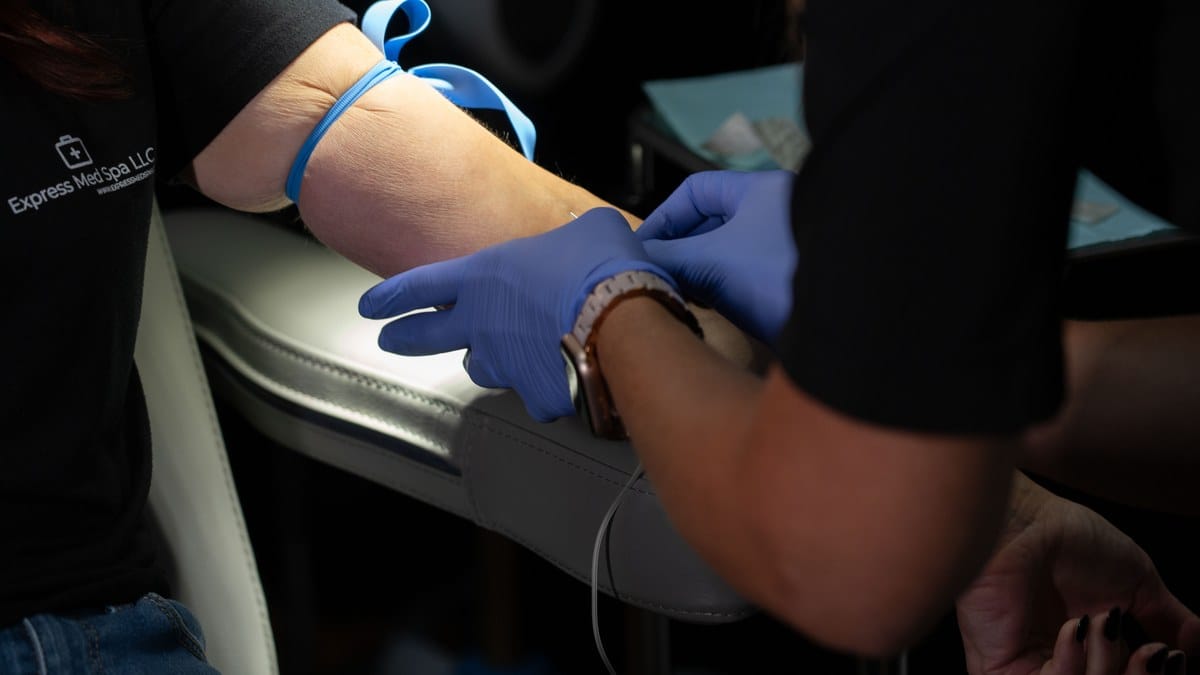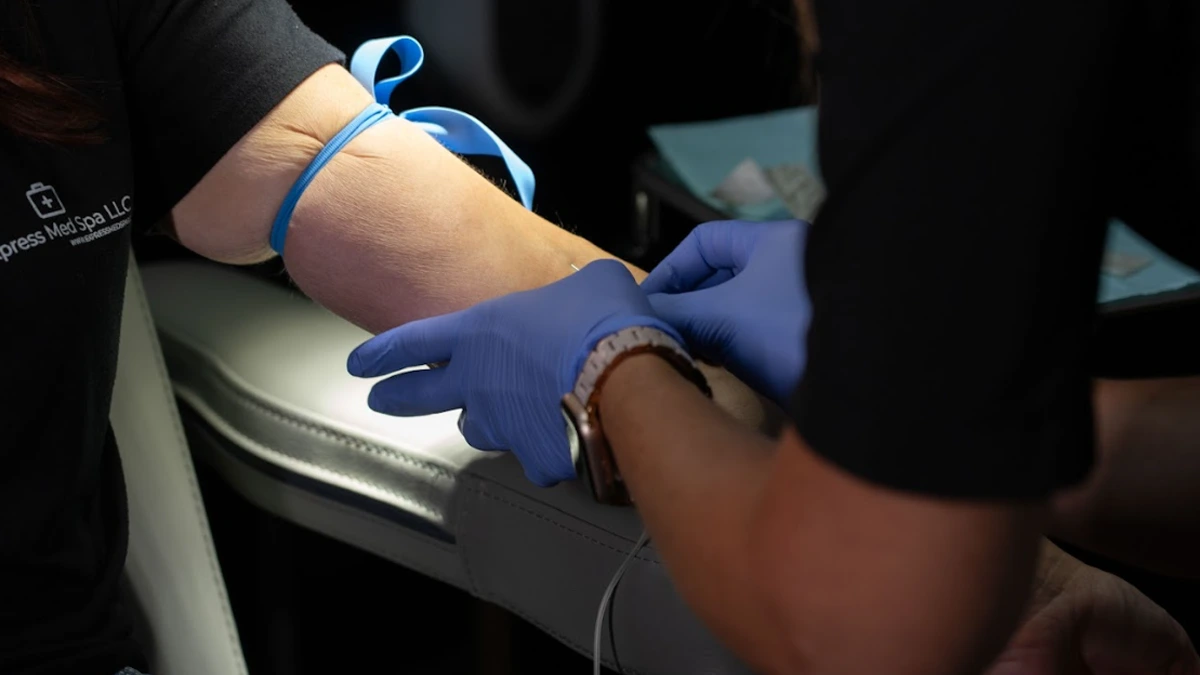
Healthcare professional drawing blood for advanced lab testing at Express Med Spa

Nurse Practitioner Led Hormone Care

Hormone Replacement Therapy in Chicagoland

Lab guided hormone replacement therapy for women and men, prescribed and monitored by our nurse practitioners at all four Express Med Spa clinics. Every plan starts with an office visit, a physical exam and a full hormone panel, so your dose is set by your own numbers rather than by a questionnaire.
Book a Hormone Consultation

Treatment TIme
15-30 min

DownTime

minimal

RESULTS TIMELINE

Dose is set from your first lab panel and adjusted at follow up visits

Result Last

Pellets are replaced every 3 to 6 months; injections run on a recurring schedule

BEST FOR

Menopause and perimenopause symptoms, Testosterone therapy for men, Lab guided hormone monitoring, Pellet therapy, Insurance billed hormone visits
  • Stefanie Drozd, Full Practice Authority Nurse Practitioner specializing in aesthetic and wellness treatments

    How does hormone replacement therapy work?

    Hormone output changes with age and life stage. Replacement supplies the hormone your labs show is low, so the goal is a measured range rather than a feeling. Your nurse practitioner runs a blood panel, reads it alongside your exam and history, and writes a prescription sized to those results. Express Med Spa prescribes estradiol and testosterone cypionate. Because dosing is set by numbers, it is checked and adjusted at follow up visits rather than left to run on its own.

  • Stefanie Drozd, Full Practice Authority Nurse Practitioner specializing in aesthetic and wellness treatments

    Which hormone programs are offered?

    Two. Hormone therapy for menopause and perimenopause uses estradiol, given as an office injection roughly every three to four weeks, and it has its own dedicated page with the full detail. Testosterone therapy uses testosterone cypionate at 50mg, 100mg, 150mg or 200mg. Both tracks also offer pellets, a small implant placed in office that releases a steady level of testosterone. Every option runs at all four clinics.

  • Stefanie Drozd, Full Practice Authority Nurse Practitioner specializing in aesthetic and wellness treatments

    What happens at a hormone therapy appointment?

    Your first visit is a 30 minute office visit: assessment, physical exam, a lab draw and prescription recommendations. Women's panels cover CBC, estradiol and testosterone. Men's add FSH, LH, prolactin and PSA where indicated. Hormones themselves are purchased separately. Once that workup is complete you become an established patient, which is what unlocks the 15 minute injection visits and the 30 minute pellet procedure.

  • Stefanie Drozd, Full Practice Authority Nurse Practitioner specializing in aesthetic and wellness treatments

    How often do you come in?

    Hormone therapy is ongoing care rather than a one time treatment. Testosterone injections are given on a recurring schedule set by your provider, and estradiol injections run about every three to four weeks. Pellets are placed every three to four months for men and every four to six months for women. Follow up visits repeat your labs, review your exam and adjust the dose, so the schedule is driven by your results.
  • Stefanie Drozd, Full Practice Authority Nurse Practitioner specializing in aesthetic and wellness treatments

    Injections or pellets, and what does it cost?

    Injections cost less per visit and are easy to adjust; some patients give them at home, and in office administration is optional. Pellets hold a steadier level and are placed only a few times a year, but a placed dose cannot be changed until the next one. Consultations are $99 with insurance, or $285 for women and $360 for men without insurance with labs included. Injections run $30 to $55. Pellets are $350 for women, $550 for men.

    About This Treatment


    Express Med Spa runs two hormone programs under one roof: hormone therapy for menopause and perimenopause, and testosterone therapy. Both are prescribed after lab work and can be delivered as an in office injection or as pellets.

    Treatment Pricing

    From
    Price
    $99

    Hormone therapy pricing at Express Med Spa depends on whether the visit is billed through insurance. The initial consultation is $99 with insurance, or $285 for women and $360 for men without insurance with lab work included at cash pricing. Follow up visits with labs are $59 with insurance or $212 without. Testosterone injections are $30 for 50mg, $35 for 100mg, $45 for 150mg and $55 for 200mg. An estradiol office injection is $55. Testosterone pellet implantation is $350 for women and $550 for men, with additional pellets at $35 each. The hormones themselves are purchased separately from the visit fee, and HMO plans are not accepted. Unlike our aesthetic services, the hormone consultation is a paid medical visit because it includes a physical exam and a full lab panel. Prices are subject to change, and your exact plan is confirmed at a planned consultation with staff.

    View our full med spa price menu

    *Pricing is subject to change.


    Who Hormone Replacement Therapy in Chicagoland is For

    Good Candidates? Is This Right for You?

    What Brings People In

    Most people book a hormone consultation because something changed and they want to know whether hormones explain it. For women in perimenopause and menopause, that is commonly hot flashes, night sweats, disrupted sleep, mood changes and irregular cycles. For men, it is commonly fatigue and a loss of muscle mass.

    These are reasons to get tested, not a diagnosis. Symptoms overlap heavily with thyroid conditions, anemia, sleep disorders and stress, which is why the visit starts with an exam and a blood panel rather than a prescription.

    Who Is a Good Candidate

    You are likely a candidate if you are an adult whose lab work shows hormone levels outside the target range your provider is working toward, and you are willing to treat this as ongoing, monitored care with repeat lab work.

    Injections and pellets are booked only for established patients who have completed the full workup and consultation. Nobody is placed on hormone therapy at Express Med Spa without labs first.

    Who Is Not a Candidate

    Hormone therapy is not appropriate for everyone. Pregnancy, breastfeeding or planning a pregnancy, a personal history of a hormone sensitive cancer such as breast or prostate cancer, a history of blood clots, stroke or heart attack, active liver disease, and undiagnosed vaginal bleeding are all reasons your provider may recommend against it or refer you elsewhere. Men with untreated sleep apnea or an elevated red blood cell count may need those addressed first.

    This list is not exhaustive, and the decision is made at your visit with your full history in front of the provider.

    Safety and Supervision

    Hormone therapy at Express Med Spa is prescribed and monitored by nurse practitioners. Dosing is set by lab work rather than by symptom questionnaires, and it is re checked at follow up visits with repeat panels. Hormone medications carry risks as well as benefits, guidance in this area has changed over time, and both are weighed against your own history and results rather than applied as a rule.


    Chicagoland Med Spa Reviews

    What Clients Say About Hormone Replacement Therapy in Chicagoland

        Contraindications & Risks / Side Effects

        Contraindications
        Pregnancy, breastfeeding, or actively planning a pregnancy
        A personal history of a hormone sensitive cancer, including breast, uterine or prostate cancer
        A history of blood clots, deep vein thrombosis or pulmonary embolism
        A history of stroke, heart attack or unstable cardiovascular disease
        Active liver disease or significantly abnormal liver function
        Undiagnosed vaginal bleeding, which needs to be evaluated before any hormone is started
        Untreated sleep apnea or an elevated red blood cell count, for testosterone therapy
        Known allergy to a component of the prescribed formulation or to the pellet materials
        Unwillingness or inability to attend follow up visits and repeat lab work

        Risks / Side Effects

        Injection site soreness, redness, swelling or bruising
        Pellet site bruising, tenderness, minor bleeding or, uncommonly, pellet extrusion or infection
        Fluid retention or swelling
        Acne or oilier skin, more common with testosterone
        Mood changes, irritability or sleep disturbance
        Breast tenderness or swelling
        Headache
        Changes to red blood cell count, cholesterol or other lab values that are tracked at follow up visits
        Unwanted hair growth or changes in hair pattern
        A dose that needs adjusting, which is why repeat labs are part of the plan and not optional

        Chicagoland Medical Spa

        EXPRESS MED SPA LOCATIONS

        Experience our expert aesthetic treatments and personalized care at our convenient Express Med Spa locations. Whether you're looking for Botox, weight loss programs, or laser hair removal, we provide advanced beauty and wellness services across our four Chicago suburbs locations.

        Express Med Spa Frankfort IL medical spa exterior serving patients from New Lenox, Mokena, Orland Park and Will County.

        Med Spa Frankfort, IL

        Our Express Med Spa Frankfort
        clinic serves Will County with nurse practitioner-led Botox,
        fillers, GLP-1 weight loss,
        and laser hair removal.

        11 S White St #104
        Frankfort, IL
        60423
        (877) 363-3772

        View Express Med Spa Frankfort →

        Get Directions
        Express Med Spa Shorewood IL medical spa exterior serving patients from Joliet, Plainfield, and Will County.

        Med Spa Shorewood, IL

        Our Express Med Spa Shorewood
        clinic serves Joliet, Plainfield, and the I-80 corridor
        with injectables, GLP-1 weight loss,
        and skin care.

        707 W Jefferson St Ste M
        Shorewood, IL
        60404
        (877) 363-3772

        View Express Med Spa Shorewood →

        Get Directions
        Exterior view of Express MedSpa La Grange clinic building showcasing modern medical spa facility.

        Med Spa La Grange, IL

        Our Express Med Spa La Grange
        clinic serves the western suburbs with Botox, fillers,
        IV therapy,
        and GLP-1 medical weight loss.

        320 W Burlington Ave
        La Grange, IL
        60525
        (708) 847-0872

        View Express Med Spa La Grange →

        Get Directions
        Exterior view of Express MedSpa clinic in Mount Greenwood Chicago showing the medical spa building.

        Med Spa Mount Greenwood, Chicago IL

        Our Express Med Spa Mount Greenwood
        clinic serves Chicago's South Side and southwest Cook County
        with nurse practitioner-led injectables, GLP-1 weight loss.

        3314 W 111th St
        Chicago, IL 
        60655
        (877) 363-3772


        View Express Med Spa Mount Greenwood →

        Get Directions
        VIEW ALL LOCATIONS & COMPARE SERVICES
        Each medical spa location is led by a licensed Nurse Practitioner, with a focus on safe, results-driven care.

        What To Expect

        Pre & Post Treatment Care

        Pre-Care Instructions
        Book the initial consultation first: injections and pellets are not available until the workup is complete
        Bring a full list of current medications and supplements, including anything hormonal
        Bring your personal and family medical history, particularly any cancer, clotting or cardiac history
        Bring your insurance card if you intend to bill the visit, and note that HMO plans are not accepted
        Ask your provider whether any of your labs require fasting when you book
        Note your symptoms and when they started, so the exam and the panel can be read against them
        For a pellet placement, wear comfortable clothing that gives easy access to the upper hip area

        Post-Care Instructions

        Keep a pellet insertion site clean and dry, and follow the dressing instructions your provider gives you
        Avoid swimming, hot tubs and submerging a pellet site for the period your provider specifies
        Avoid vigorous lower body exercise for a few days after a pellet placement
        Expect mild soreness or bruising at an injection or pellet site, and use a cold compress if needed
        Attend your follow up visit and complete the repeat lab work, because dosing is adjusted from those results
        Report a fever, spreading redness, drainage or a pellet working its way out to the clinic promptly
        Report chest pain, shortness of breath, or new leg swelling or pain urgently, as these are not expected effects
        Keep taking any other prescribed medication as directed unless your provider tells you otherwise
        • How Hormone Replacement Therapy Works

          Hormone output changes across a lifetime. Through perimenopause and into menopause, a woman’s estrogen production falls and fluctuates, often for years before periods stop altogether. In men, testosterone declines gradually with age. Hormone replacement therapy supplies the hormone your blood work shows has dropped, so the aim is to bring a measured value back toward a target range your provider sets with you.

          That distinction is what separates a medical hormone program from a supplement. Symptoms on their own do not establish which hormone is low, and several unrelated conditions produce overlapping symptoms: thyroid disease, anemia, sleep disorders and sustained stress can all present much the way a hormone decline does. Express Med Spa therefore does not prescribe from a questionnaire. A nurse practitioner takes a history, performs a physical exam, draws blood, and reads the panel next to what you reported before writing anything.

          Two prescription medications carry the programs. Estradiol is the estrogen used for menopause and perimenopause care. Testosterone cypionate is the testosterone used for testosterone therapy, and testosterone is also what the pellets deliver, for women as well as men. Both are given by intramuscular injection, which places the dose in muscle where it is absorbed over days rather than all at once. These are prescription drugs dispensed under a treatment plan, and the hormones themselves are purchased separately from the visit.

          Because the target is a number rather than a feeling, the plan does not stay fixed once it is written. Follow up visits repeat the panel and your provider moves the dose against the new result. Hormone therapy is ongoing care that is monitored and revised. It is not a course of treatment that finishes on a set date, and it is not something you would expect to start and then leave alone.

        • The Two Hormone Programs at Express Med Spa

          Express Med Spa runs two hormone therapy tracks, and both are available at every clinic: Frankfort, La Grange, Shorewood and Mount Greenwood in Chicago.

          Menopause and perimenopause hormone therapy is built around estradiol, given as a 5mg office injection on roughly a three to four week cycle. That program has its own page: see menopause and perimenopause hormone therapy for the labeled indications, the current position on hormone therapy labeling, and the detail on how that track runs. If menopause is what brought you here, start there rather than on this page.

          One point belongs on any page that mentions systemic estrogen. A woman who still has a uterus needs a progestogen alongside estrogen to protect the lining of the uterus. Express Med Spa does not carry a progestogen on its own injection menu, so where one is indicated it is prescribed and filled separately. Raise it at your consultation rather than assuming it is included.

          Testosterone therapy is built around testosterone cypionate, given as an intramuscular injection at 50mg, 100mg, 150mg or 200mg, so a provider can move a dose in steps. It also has its own page: see testosterone replacement therapy for the men’s panel and that program’s detail.

          Pellets sit across both tracks. A pellet is a small implant placed under the skin during a 30 minute in office procedure, releasing a steady level of testosterone between placements. Women are typically started on one to two pellets depending on what their labs show; the standard placement for men is six. Additional pellets can be added at a placement when results call for it.

          One point deserves stating plainly, because a great deal of published material blurs it: the pellet offered here is a testosterone pellet, for women and men alike. Estrogen at Express Med Spa is delivered by injection, not by pellet.

          Hormone therapy sits with the medical services on this menu rather than inside the aesthetic line. If you arrived here from B12 injections or IV therapy, this is a different kind of program: prescription medication, ongoing lab monitoring and scheduled follow up.

        • Your First Visit: Exam, Lab Work and a Plan

          Every hormone plan starts with a 30 minute office visit with a nurse practitioner. It is a clinical appointment rather than a sales consultation, and it is a paid visit: $99 when billed through insurance, or $285 for women and $360 for men on a cash basis with the labs included in that figure.

          The visit covers four things: an assessment of your history and what prompted the appointment, a physical exam, a blood draw, and prescription recommendations based on what comes back.

          The panel is matched to the program. A women’s hormone workup runs CBC, estradiol and testosterone. A men’s workup runs CBC, estradiol, testosterone, FSH, LH and prolactin, adding PSA where it is indicated.

          Those extra markers on the men’s panel are not padding. FSH and LH are the pituitary signals that tell the testes to produce testosterone, so they show whether a low reading is coming from the gland itself or from the signal reaching it, and that changes what a provider recommends. Prolactin is checked because an elevation there suppresses testosterone through a different mechanism entirely. Estradiol appears on both panels because men convert a share of their testosterone into estrogen, and that conversion matters once a dose is running.

          Bring a full list of your current medications and supplements, including anything hormonal you are already taking, and your personal and family history for cancer, clotting and cardiac events. Those are the details that most often change a recommendation, and they are easier to give from a list than from memory in the room.

          Three practical notes. The hormones are purchased separately from the visit fee, so the consultation price buys the workup rather than the medication. Injections and pellets are booked only for established patients who have completed this full workup, which is why a first appointment cannot be a walk in for a shot. And cash lab pricing is available if you are not billing insurance, though HMO plans are not accepted at any location.

        • Ongoing Care: Injections, Pellets and Follow Ups

          Once your workup is complete and a prescription is in place, the appointments get short and routine.

          Injection visits run 15 minutes. A provider administers the recommended dose of testosterone cypionate or estradiol. This visit is optional by design: Express Med Spa describes it as a service for patients who are not comfortable administering hormones at home, which means self administration is the expected route for many people once they are established. Injection training is available if you would rather have the technique taught before you take it on.

          Pellet placement runs 30 minutes. It is an in office procedure in which pellets are placed under the skin, after which they release testosterone steadily until the next placement. Women are started on one to two pellets depending on lab results; men are placed with a standard six. The site needs ordinary wound care for a few days afterward, and vigorous lower body exercise and submerging the site are worth avoiding for the period your provider specifies.

          Follow up visits run 15 minutes and are where the plan gets corrected. Each one repeats the lab work, a CBC, estradiol and testosterone, alongside a physical exam and assessment, and your provider adjusts the medication from there. Follow ups are $59 through insurance or $212 on a cash basis with the labs included.

          The phrase established patient does real work in that sequence. It is what the short appointments depend on, and it means the exam, the panel and the prescription are already on file, so a 15 minute visit can be exactly that rather than a compressed consultation. It is also why a lapse in follow up visits eventually interrupts the shorter ones: without current labs there is nothing to dose against.

          No good faith exam requirement applies to these visits, and none of them carries meaningful downtime. Injection and follow up appointments are short enough to fit into a working day, and a pellet placement asks only that you take it easy for a few days afterward.

        • Timelines, Dosing Cadence and Monitoring

          Hormone therapy does not have a finish line the way a course of facials does. It is ongoing care, and the honest answer about how quickly anyone responds is that it varies between people and is tracked with lab work rather than promised in advance. What can be stated precisely is the schedule.

          Estradiol injections are given roughly every three to four weeks. Testosterone injections run on a recurring schedule your provider sets, which is part of why four strengths are stocked: the interval and the dose are adjusted together rather than one at a time.

          Pellets last months rather than weeks. Placement is recommended every three to four months for men and every four to six months for women. That is the practical appeal of the pellet route, roughly three appointments a year in place of a recurring injection schedule.

          Monitoring is the part that does not change. Follow up visits repeat your panel, and the dose is revised against those numbers rather than against how the last few weeks felt. A plan that appears to be working still gets re checked, because the point of a lab guided program is that the labs, not the calendar, decide what happens next.

          The follow up panel is not only checking whether the target hormone moved. It repeats a CBC, because testosterone can raise red blood cell counts, and it repeats estradiol alongside testosterone, because the balance between the two shifts once a dose is running. A provider reading that panel is watching several values at once rather than a single number.

          Expect the first months to involve more adjustment than the ones that follow. Levels are being found rather than maintained, and a dose that reads correctly on one panel can need moving on the next. If your labs shift, your prescription shifts with them. That is the expectation to carry into the program, and it is why the follow up visit is priced as part of the pathway rather than sold as an add on.

        • Injections Compared With Pellets

          Both routes deliver testosterone, and both are offered at all four clinics. They differ in five ways that usually decide it.

          How often you come in. Injections are a recurring schedule, and estradiol runs about every three to four weeks. Pellets are placed every three to four months for men and every four to six months for women, so roughly three appointments across a year.

          Who administers it. Injections can be self administered at home once you are established, with in office visits available whenever you want them. Pellet placement is always an in office procedure performed by your provider.

          How steady the level is. A pellet releases continuously between placements. An injection schedule produces a rise and fall between doses, which is one reason interval and strength are adjusted together.

          How easily the dose changes. This is the real trade off. An injection dose can be moved at the next appointment across four strengths from 50mg to 200mg. Once pellets are placed they release until they are spent, so a change generally waits for the next placement.

          What it costs across a year. The per visit figures look very different from the annual ones, because an injection is $30 to $55 while a pellet placement is $350 or $550. Run each number against the cadence that route actually uses before drawing a conclusion from the sticker price.

          What the appointment itself involves. An injection is a routine intramuscular shot. A pellet placement is a small in office procedure with an insertion site that needs ordinary wound care and a few quiet days afterward. Neither is a significant undertaking, but they are not the same kind of visit, and that matters to some people more than the schedule does.

          Neither route is presented here as the better one. Convenience points toward pellets and flexibility toward injections, and that is the trade off your provider walks through against your labs at the visit.

        • What Hormone Therapy Costs and How Insurance Fits

          Express Med Spa publishes hormone therapy pricing, and the structure is unusual for a med spa because these visits can run through insurance. That is why almost every figure below comes as a pair.

          Initial consultation, with insurance: $99, for women and men alike. Without insurance the visit is $285 for women or $360 for men, and the labs are included in that figure at cash pricing.

          Follow up visits with labs: $59 through insurance, or $212 on a cash basis.

          The gap between those pairs is mostly the labs. A hormone panel run on a cash basis is the single largest line in the visit, which is why the cash consultation costs roughly three times the insurance one while covering the same appointment. It is also why the men’s cash consultation is higher than the women’s: the men’s panel runs more markers.

          Injections: testosterone at $30 for 50mg, $35 for 100mg, $45 for 150mg and $55 for 200mg. An estradiol office injection is $55.

          Pellets: $350 for women and $550 for men, with additional pellets at $35 each when your labs call for them.

          Individual labs can also be run on a cash basis outside a bundled visit, including estradiol at $86 and total testosterone at $91, with an insurance lab draw fee of $59.

          Two things are commonly misread. The hormones themselves are purchased separately, so a consultation fee covers the workup and not the medication. And unlike the aesthetic services on this site, the hormone consultation is a paid medical visit rather than a no charge one, because it includes a physical exam and a full lab panel drawn on the day. HMO plans are not accepted at any of the four clinics.

          Prices are subject to change, and your own plan is confirmed at a planned consultation with staff.

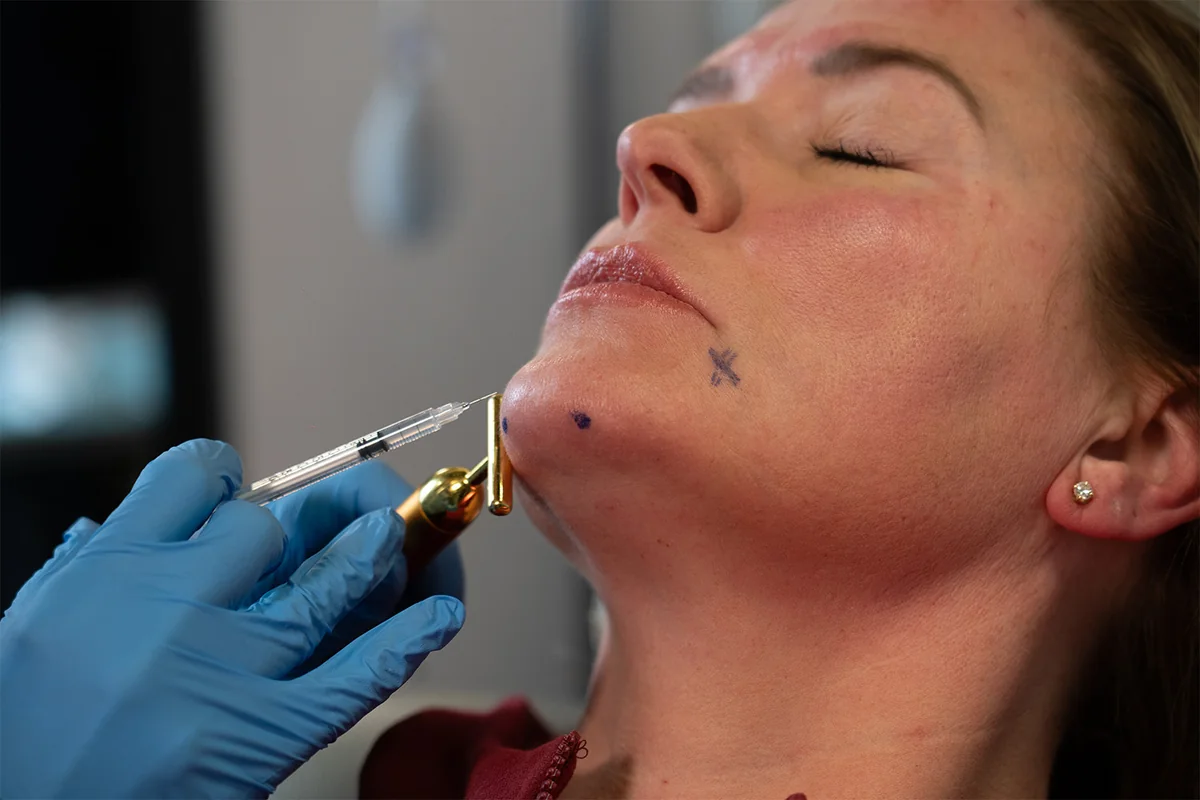
          Facial treatment for hydration, glow, and smoother skin texture during a spring appointment at Express Med Spa.

          CommON QUESTIONS

          Hormone Replacement Therapy in Chicagoland FAQs