
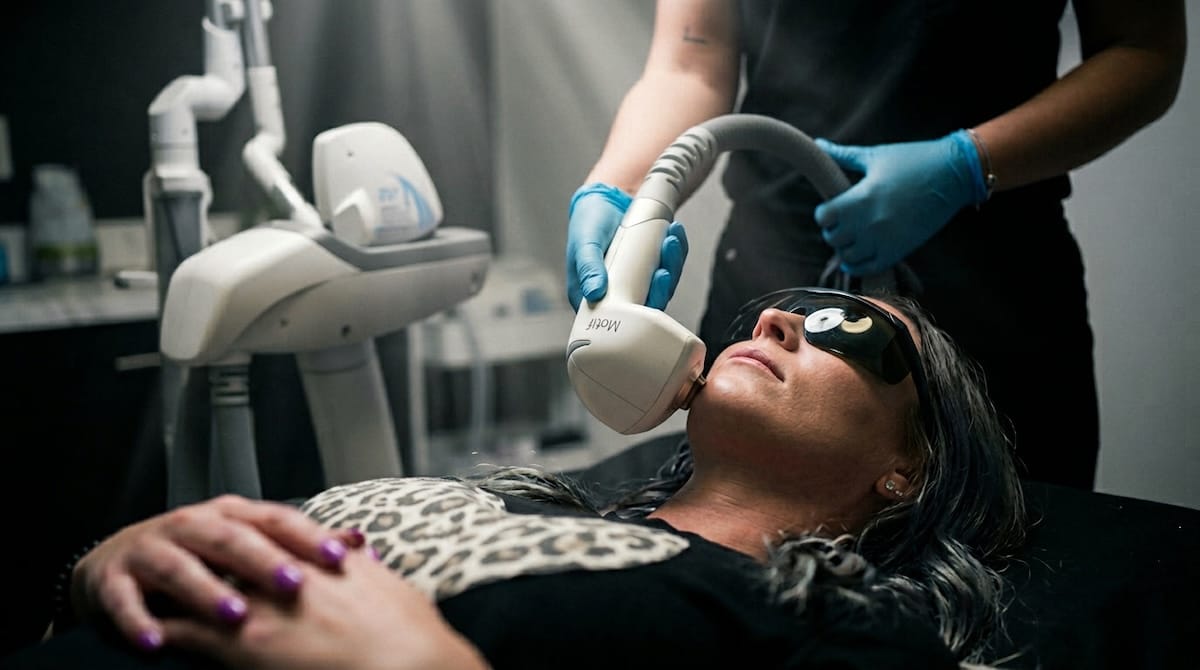
Laser Treatments & Hair Removal
Most people need 6 to 12 laser hair removal sessions, spaced about 5 to 6 weeks apart, to finish a full course on a given area. That range is not padding. It exists because a laser can only disable a follicle that is actively growing at the moment of treatment, and your follicles are never all in that phase at once. The number you personally need depends on where you are treating, how coarse the hair is, and how dark it is.
In a short video on how laser hair removal works, Stephanie Guenther, RN, an aesthetic nurse injector at Express Med Spa, walks through the same timeline from the treatment room: what the laser can and cannot target, what changes after each block of sessions, and why she still recommends maintenance after a course is finished. This guide expands on that with pricing, aftercare, and candidacy detail.
Table of Contents
How Many Laser Hair Removal Sessions Do You Need?
Plan on 6 to 12 sessions for a complete course, scheduled roughly 5 to 6 weeks apart. Where you land inside that range comes down to three variables that your provider assesses at your consultation.
- Location on the body. Hair on the face cycles faster than hair on the legs or back, so facial areas often need visits closer to the upper end of the range.
- Coarseness of the hair. Thick, dense hair typically responds visibly earlier, but a dense area may still need the full course to thin out evenly.
- Color of the hair. The laser targets pigment, so darker hair gives it a clearer target than lighter hair does.
Two people treating the same area can finish on different schedules, and that is normal. A course is not a fixed package you either complete or fail; it is a series of passes, each one reducing what grows back. Results vary from person to person.
At a consultation your provider looks at the area itself rather than working from a chart. They assess how dense the growth is, how much contrast there is between your hair and your skin, and whether the hair is coarse enough to hold heat well. From there you get a realistic estimate and a booking cadence, and that estimate is revisited as your course progresses. It is common to be told partway through that you need fewer sessions than first expected, or that one stubborn area needs a couple extra.
Why Sessions Are Spaced 5 to 6 Weeks Apart
The spacing is the part people most often try to shortcut, and it is the part that matters most. Laser hair removal works by sending light into the hair shaft, where dark pigment absorbs it and converts it to heat. That heat travels down the shaft to the follicle. If the follicle is in its active growing phase, the heat can disable it. If that same follicle is dormant, there is no meaningful connection between the visible hair and the structure that produces it, and the pass does little.
At any given moment only a portion of the follicles in an area are in that active phase. This is why booking sessions two weeks apart does not speed anything up. You would simply be treating the same follicles that were already handled, while the ones that had been dormant have not yet cycled into range. Waiting 5 to 6 weeks lets a fresh group become treatable, so each visit works on hair the previous visit could not reach.
It also explains why shaving between sessions is fine but waxing, plucking, and epilating are not. Those methods pull the follicle out entirely, which removes the target the laser needs. Shaving leaves the follicle in place and simply trims what sits above the skin.
What Changes After Each Block of Sessions
Progress tends to arrive in stages rather than all at once. Stephanie describes the arc in three blocks.
Sessions 1 and 2: the texture changes first
After the first couple of sessions, hair typically grows back lighter, softer, and more sporadic. Many people expect bare skin at this stage and are surprised when hair returns at all. What has changed is the quality of the regrowth, not the presence of it. That softening is the early signal the treatment is doing its job.
Sessions 3 to 5: patchiness sets in
Through the middle of the course the area starts to feel patchy. Some sections clear noticeably while others still produce hair, because the follicles in each section were on different cycles when treatment started. Uneven progress here is expected and is not a sign the course is failing.
Sessions 6 to 10: cleanup and maintenance
The later sessions function as cleanup. Rather than clearing large amounts of hair, they catch the stragglers that were dormant during earlier visits and even out the areas that lagged behind. Sessions in this block often feel quicker and more comfortable simply because there is less hair to treat.
Is Laser Hair Removal Permanent?
The follicles disabled during treatment are permanently disabled. That part is genuinely lasting, and it is why a completed course produces a durable reduction rather than a temporary one.
The nuance is that your body can develop new follicles over time. Hormonal shifts, including those around pregnancy, perimenopause, and conditions such as PCOS, can activate follicles that were not producing visible hair when you were treated. Those new follicles were never treated, so their appearance is not a sign that earlier results reversed.
This is why maintenance is recommended once or twice a year after a course is complete. A maintenance visit is typically shorter and less involved than a treatment in the initial series. If hormonal hair growth is the reason you are considering treatment, our guide to laser hair removal for PCOS covers what to expect in more detail.
Which Hair Colors Laser Hair Removal Can Treat
Laser hair removal needs pigment to work. The laser finds the hair by its darkness, which means the treatment is effective on darker hair and ineffective on hair that lacks pigment. As Stephanie puts it, the lasers will not pick up on non-pigmented white hair or very light blonde hair.
In practice that means:
- Treatable: black, dark brown, and medium brown hair, including coarse hair on the face, body, and bikini line.
- Limited response: light brown and darker blonde hair, which may respond but often less predictably.
- Not treatable: white, gray, and very light blonde hair, along with most red hair, because there is not enough pigment for the laser to target.
An honest consultation matters here. If your hair will not respond, the responsible answer is to tell you before you pay for a course rather than after. That assessment is part of every laser hair removal consultation at Express Med Spa.
For a closer look at each light hair color, and what to do if yours is too light for laser, see does laser hair removal work on blonde, gray, or red hair.
Which Areas Can Be Treated, and Which Are Most Sensitive
Laser hair removal can be performed on nearly any area where you grow hair, from the face all the way down to the toes. Common requests include the underarms, bikini and Brazilian areas, legs, arms, back, chest, stomach, neck, and smaller facial areas such as the upper lip, chin, and sideburns. For facial work specifically, see our face laser hair removal page, and for full-face treatment our guide to full face laser hair removal covers the details.
Sensitivity is not uniform across the body. The areas Stephanie identifies as most sensitive are the underarms, the upper lip, and the bikini and Brazilian areas. These regions combine thinner skin with denser, coarser hair, which means more pigment absorbing more energy in a smaller space. Most people describe the sensation as a quick snap rather than sustained pain, and settings can be adjusted for comfort. If discomfort is your main hesitation, our article on whether laser hair removal hurts goes into what the sessions actually feel like.
Tattooed skin is a separate consideration. A hair removal laser cannot distinguish tattoo ink from hair pigment, so providers treat around tattoos rather than over them. Our explainer on whether laser hair removal fades tattoos covers how that is handled safely.
Many clients treat more than one area in the same visit, which is worth raising at your consultation because it affects both scheduling and cost. Combining areas does not change the 5 to 6 week spacing, since every area follows the same follicle cycle logic, but it does mean one appointment rather than several across the month.
Downtime and Aftercare
There is no downtime after laser hair removal. You can return to work and normal activity the same day. The aftercare guidance is short and worth following closely, because the skin has just absorbed heat even though nothing about it looks dramatic.
- Avoid extreme heat immediately after. That means no saunas and no hot tubs right after your session, since added heat compounds what the treatment already delivered.
- Treat the area like a mild burn. Keep it clean, be gentle with it, and skip aggressive scrubs or exfoliants for a few days.
- Expect possible redness, not damage. Redness can be present from the heat and typically settles on its own. You should not have discoloration, burning, or scarring.
- Shave between sessions if needed. Shaving is fine. Waxing, plucking, and epilating are not, because they remove the follicle the laser needs to find.
- Protect treated skin from the sun. Sun exposure on freshly treated skin is worth limiting, and daily SPF is sensible throughout a course.
If anything about your skin’s response concerns you between visits, contact the clinic rather than waiting for your next appointment.
How Laser Hair Removal Compares to Waxing and Shaving
The clearest difference is what each method acts on. Shaving cuts the hair at the surface and leaves the follicle untouched, so regrowth appears within days. Waxing pulls the hair out from the root, which buys several weeks, but the follicle itself stays intact and simply produces another hair. Laser hair removal is the only one of the three that targets the follicle’s ability to produce hair at all, which is why its results accumulate across a course instead of resetting after each appointment.
That difference also changes how the three interact. You can shave freely during a laser course, because shaving leaves the follicle in place for the laser to find. You cannot wax, pluck, or epilate during a course, because those methods remove the very target the laser depends on. If you are currently a regular waxer and want to switch, plan to stop waxing before you begin and shave instead in the weeks between sessions.
The trade-off is time and structure. Shaving and waxing are ongoing and indefinite; laser hair removal asks for a defined commitment of 6 to 12 sessions across several months, after which most people move to occasional maintenance rather than a continuing routine. Which one suits you depends on your hair color, your tolerance for a multi-month schedule, and whether reduction or temporary removal is the goal. Hair that lacks pigment will not respond to the laser, in which case waxing or shaving remains the practical option.
Laser Hair Removal Pricing at Express Med Spa
Pricing tracks the size of the area being treated:
- Small areas start at $50 per session. These include the lip, brow, ear, sideburn, and toes.
- Mid-size areas are $75 per session. These include the underarm, bikini, chest, stomach, neck, scalp, or a half limb.
- Large areas are $100 per session. These include a full leg, full arm, back, Brazilian, or Full Face.
- A Full Body package covering up to six areas is $399. Clients treating several areas at once often choose this option.
Because a full course typically runs 6 to 12 sessions, it is worth thinking about the total rather than the per-visit figure when you plan. Our laser hair removal cost guide breaks that math down by area. A consultation is the only way to confirm what your specific areas and hair type will require. Prices are subject to change.
Where We Offer Laser Hair Removal
Laser hair removal is available across our Chicagoland locations. You can book at Express Med Spa Frankfort, La Grange, Shorewood, or Chicago Mount Greenwood.
Each location has a dedicated laser hair removal page with local details: Frankfort, La Grange, Shorewood, and Mount Greenwood.
Ready to find out how many sessions your areas will need? Book a laser hair removal consultation online, or call 877-363-3772.
About Your Provider
Stephanie Guenther, RN, is an aesthetic nurse injector at Express Med Spa who performs laser hair removal alongside her injectable work. The session timeline, sensitivity guidance, and aftercare in this guide reflect how she explains the treatment to her own clients, including the point she returns to most often: the follicles treated are permanently disabled, but new follicles can develop later, which is what maintenance visits are for.
Frequently Asked Questions
How many laser hair removal sessions do I need?
Most people need 6 to 12 sessions on a given area, spaced about 5 to 6 weeks apart. The exact number depends on where you are treating, how coarse the hair is, and how dark it is. Facial areas often need visits toward the higher end of that range. Your provider confirms a plan at consultation. Results vary.
Why do I have to wait 5 to 6 weeks between sessions?
A laser can only disable a follicle that is actively growing when it is treated, and only some of your follicles are in that phase at any time. Waiting 5 to 6 weeks lets a new group cycle into that phase, so each visit reaches hair the previous one could not. Booking sooner does not speed up the course.
Is laser hair removal permanent?
The follicles disabled during treatment are permanently disabled. However, your body can develop new follicles over time, often due to hormonal changes, and those were never treated. This is why maintenance once or twice a year is recommended after a course is finished rather than treating the result as final.
Does laser hair removal work on blonde or gray hair?
Generally no. The laser targets pigment in the hair, so it will not pick up non-pigmented white hair, gray hair, or very light blonde hair. Dark brown and black hair respond best. Light brown and darker blonde hair may respond less predictably. A consultation is the way to confirm whether your hair will respond.
Which areas are most sensitive during laser hair removal?
The underarms, upper lip, and the bikini and Brazilian areas tend to be the most sensitive, because thinner skin combines with denser, coarser hair. Most clients describe the sensation as a quick snap rather than sustained pain, and settings can be adjusted for comfort during the session.
Can I shave between laser hair removal sessions?
Yes. Shaving is fine and is usually encouraged, because it trims the hair above the skin while leaving the follicle in place. Avoid waxing, plucking, and epilating during your course, since those remove the follicle the laser needs to target and can set your progress back.
How much does laser hair removal cost at Express Med Spa?
Pricing tracks area size: small areas start at $50 per session, mid-size areas are $75, and large areas are $100. A Full Body package covering up to six areas is $399. Because a full course usually runs 6 to 12 sessions, plan around the total rather than a single visit. Prices are subject to change.
How does laser hair removal compare to waxing?
Waxing pulls hair out from the root but leaves the follicle intact, so it regrows on a cycle of several weeks indefinitely. Laser hair removal targets the follicle itself, so results build across a course of 6 to 12 sessions. You also cannot wax during a laser course, because it removes the target the laser needs. Shave instead.
Is there downtime after laser hair removal?
There is no downtime, and you can return to normal activity the same day. Avoid saunas, hot tubs, and extreme heat immediately afterward, and treat the area gently, like a mild burn. Redness from the heat can occur and usually settles on its own. You should not have discoloration or scarring.
Meet our nurse practitioner-led team.That’s exactly why we offer free consults.
Meet our nurse practitioner-led team.
That’s exactly why we offer free consults.
🧬 Personalized care that fits your goals.

Stefanie Drozd, APRN
Founder & Nurse Practitioner
354
5 Star Average Rating
Five Star Reviews... and growing
Let’s Talk About Your Skin Goals
You don’t have to guess what treatment is right for you. Book a complimentary consultation and let our licensed professionals help you choose the safest and most effective option. We will walk you through your options and help you decide what makes the most sense for your skin, goals, and budget.Express Med Spa Team
Share

Personalized, Judgment-Free Care
That’s exactly why we offer free consults.
🧬 Just personalized care that fits your goals.
Stefanie Drozd, APRN
Founder & Nurse Practitioner
You don’t have to guess what treatment is right for you. Book a complimentary consultation and let our licensed professionals help you choose the safest and most effective option. We will walk you through your options and help you decide what makes the most sense for your skin, goals, and budget.Express Med Spa Team
354
5 Star Average Rating
Five Star Reviews... and growing
Let’s Talk About Your Skin Goals